

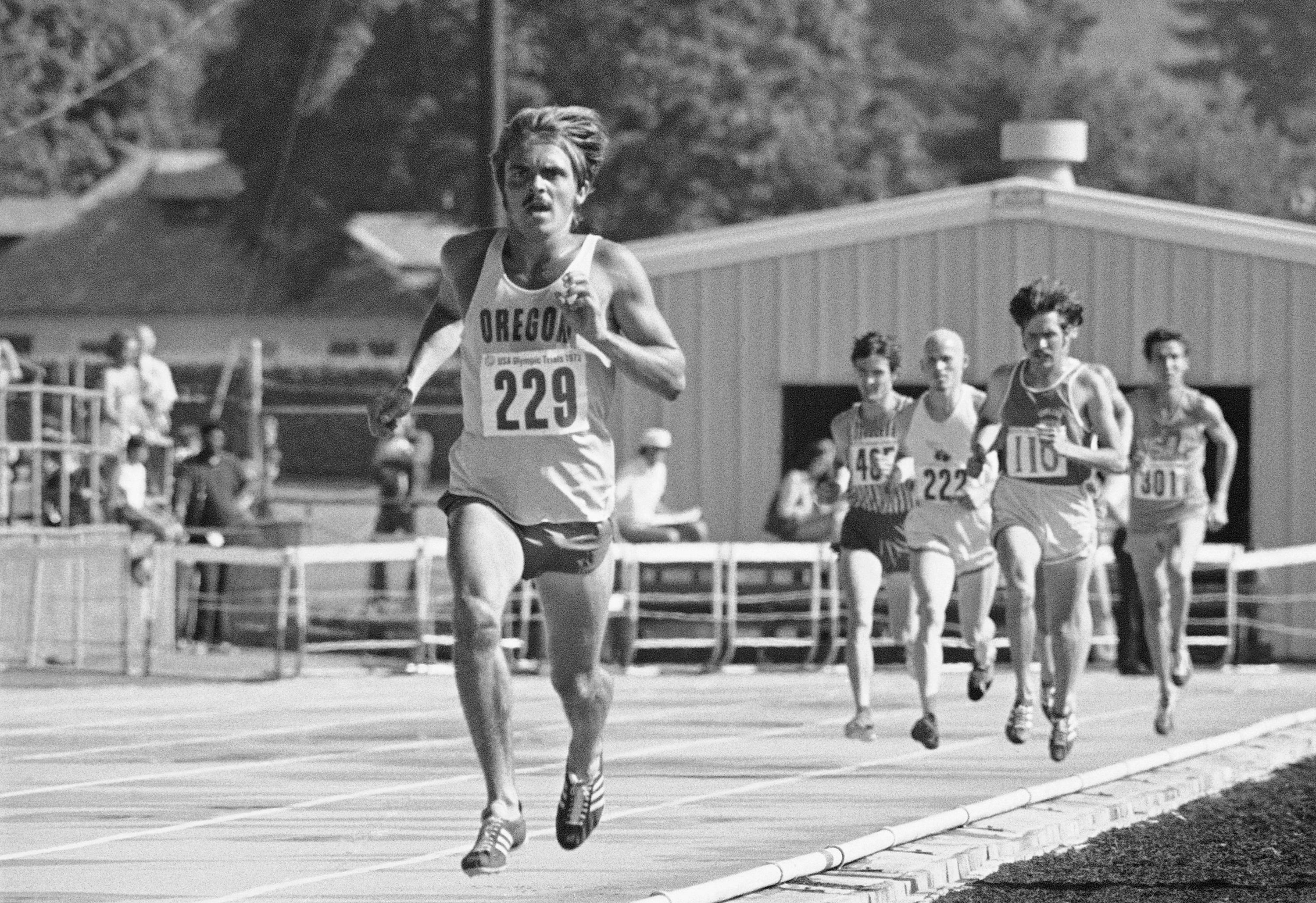
The Front Runner
On a recent college scouting trip to the University of Oregon, I visited a solemn roadside memorial with my teenage son. On a rainy day in November, we stood before a mossy outcrop at the bend in Skyline Boulevard where one of the most prodigal and charismatic runners of the 1970s died in a car crash at the age of 24.
On May 30, 1975, Steve Prefontaine was driving home from a party when his ‘73 gold MG convertible ran off the road, hit this rock, and flipped, pinning him. He had a blood alcohol level of 0.16%, above the legal limit. I wanted my son to see this proof of vincibility, hoping it would leave an impression more lasting than a motherly lecture.
We were touring Eugene with my friend Brendan O’Meara, whose biography, The Front Runner, chronicled Prefontaine’s life and lasting impact on distance running.
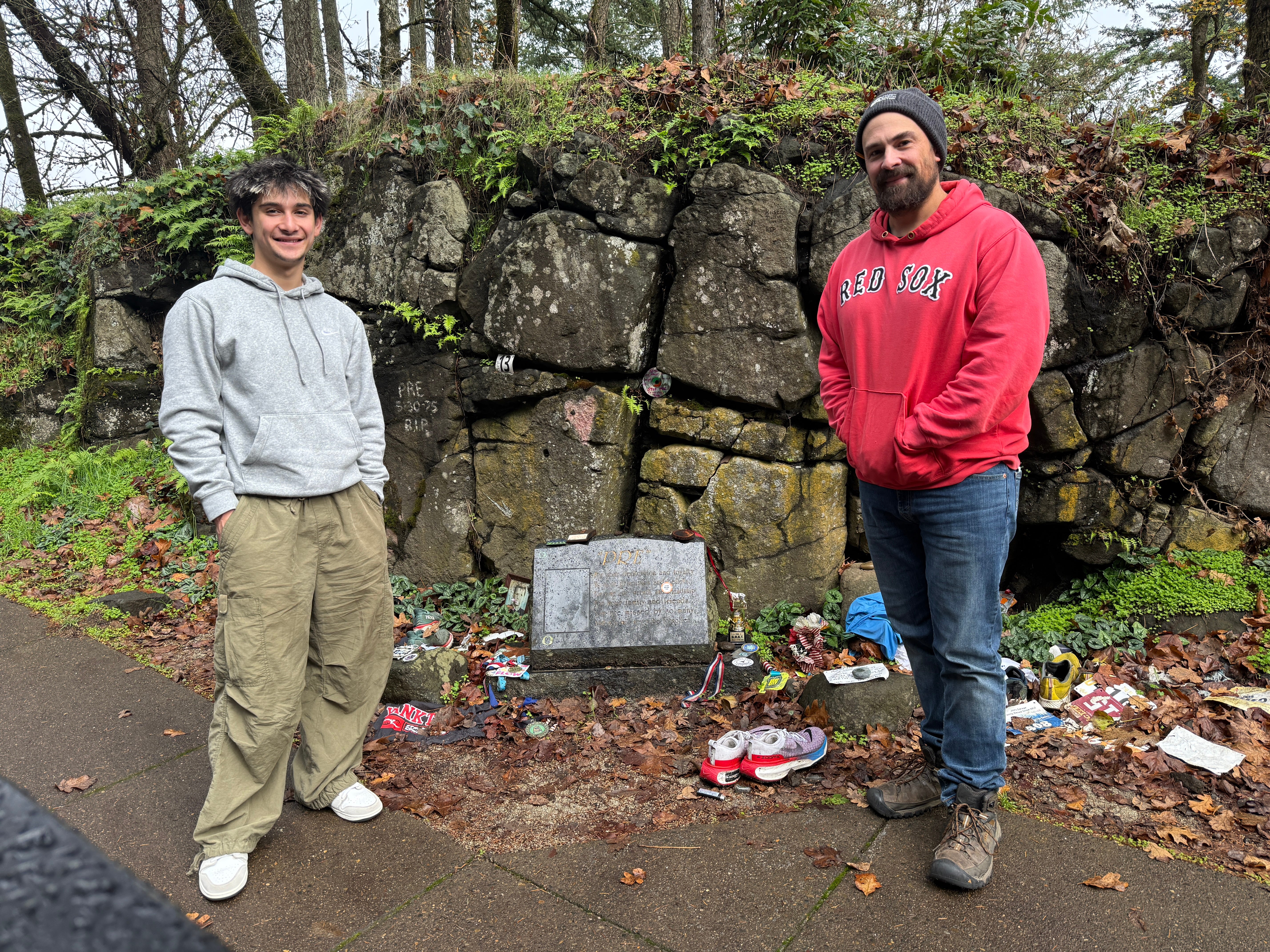
As always, “Pre’s Rock” was littered with medals, race numbers, running shoes, and other mementos left by visitors who’d made the pilgrimage. One of those pilgrims was Lance Armstrong, who’d recently Instagrammed a photo of his visit. “First trip to Eugene, Oregon and the one spot I knew for sure I had to visit was Pre’s Rock,” Armstrong wrote. “I get asked from time to time, ‘If you could have dinner with anybody, alive or not, who would it be?’ Personally, I’d pick a table for 4. Steve Prefontaine gets a seat every single time.”
Before I read The Front Runner, I didn’t know much about Prefontaine, the charismatic middle-distance runner who became the first celebrity face of Nike. Confession: I hate running. It’s a sport I’ve always dreaded, endured, and considered as a painful means to a worthy end: a faster way to get to the soccer ball or finish a triathlon. But I connected with the sport through Brendan’s biography. Why? Interiority.
Getting inside a character’s head
“Interiority” is a new and intimidating word to me. I like to think of it as “getting inside your character’s head.” Doing it well is is one of the most challenging elements of narrative nonfiction. Even when you can interview your subject—and ask what they were thinking, feeling, and doing in a particular scene—it’s still hard to capture their point of view with accuracy and nuance. When they’re not around (or willing) to be interviewed, it’s exponentially harder.
Pre died five years before Brendan (who lives in Eugene) was born. So the author had to get to know his subject intimately, without the chance to meet or interview him. And in his work on an unauthorized biography, he faced an additional hurdle: primary sources unwilling to consent to an interview.
Brendan shared his challenges, solutions, and overall process in a Nieman Storyboard Annotation of a chapter excerpt. If you’re new to Nieman Storyboard, it’s Harvard’s platform dedicated to the craft of telling true stories. An Annotation is like a Director’s Cut: a conversation between writers about craft. The conversation plays out in the text itself.
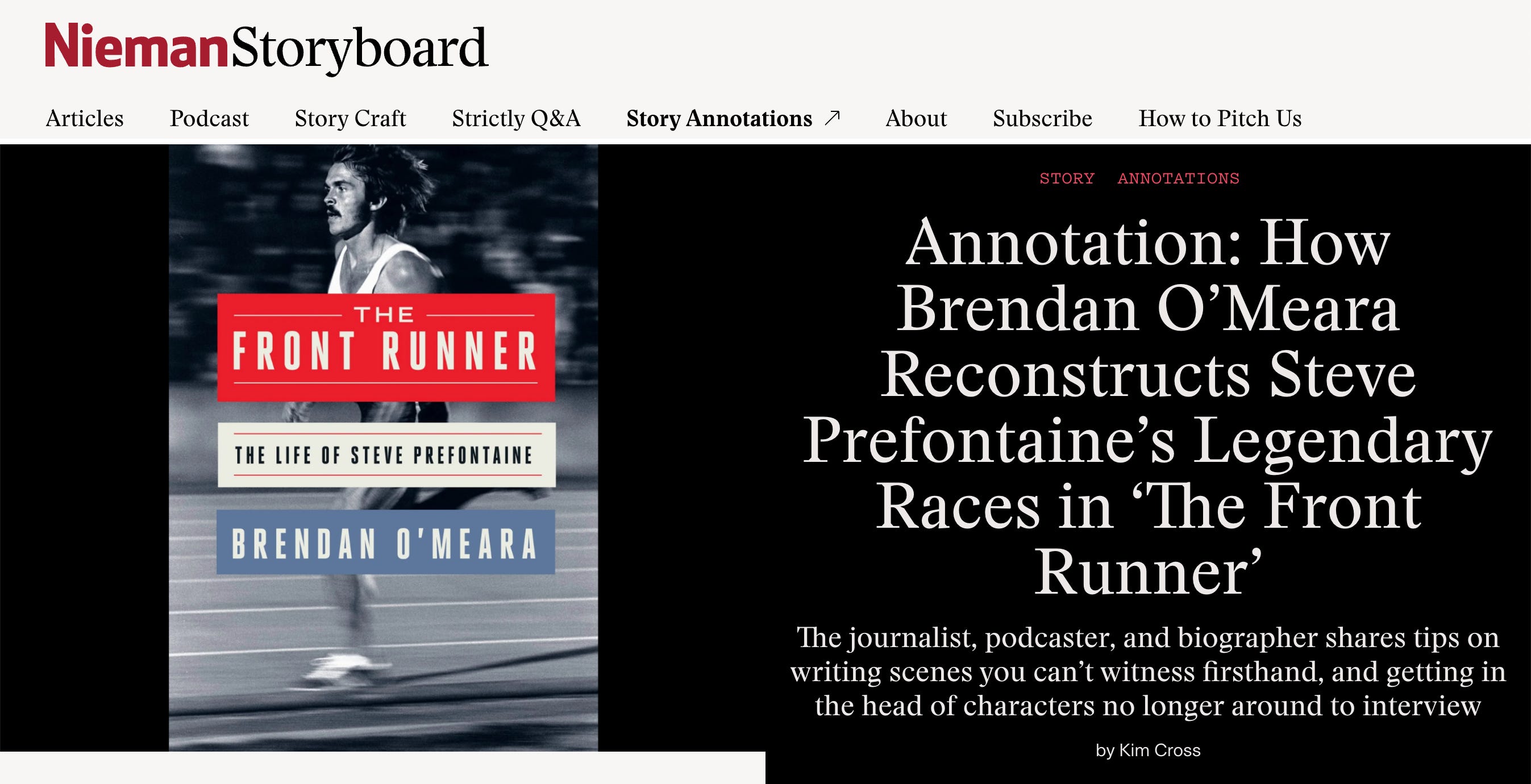
I consider Storyboard Annotations one of my favorite sources of continued education. Every great narrative is a master class in and of itself, and I learn so much from reading (or hearing) writers discuss the reporting and writing decisions that went into it. My other favorite way to study the craft is to listen to podcasts of writers talking about their process. In the graduate feature writing class I teach for Harvard Extension School, my reading list consists of narratives paired with a podcast or Annotation.
One of the podcasts on my syllabus is The Creative Nonfiction Podcast, on which Brendan interviews writers like Susan Orlean, Laura Hillenbrand, and David Grann. (The 500th episode featured my longtime literary crush: John McPhee.) A generous literary citizen who is always spotlighting other writers, Brendan also has a Substack called Pitch Club, where he breaks down successful story pitches with intel from the writers. Both are excellent resources on the business and craft of nonfiction writing.
Paying subscribers to The Waterproof Notebook will get a bonus post with Brendan’s biography tips for mining archives for vivid scenes, organizing research for book-length writing projects, and fact-checking conflicting details when secondary sources disagree. I’m also going to do my first product giveaway soon—another perk for paying subscribers. Thanks for supporting my work, either way!
More Running Reads
50 Years Ago, He Was an Olympian. At 80, He’s Just as Happy to Finish Last
In the 1970s, Olympian Jeff Galloway created a Run-Walk-Run method that helped runners train for marathons and longer-distance events with a reduced risk of injury. In this NYT feature, Danielle Friedman shows how Galloway’s decades of training likely saved his life during a heart attack in his 70s.
Bonus: Give the Galloway Method (aka “Jeffing”) a try with his Run Walk Run app.
Better, Faster, Farther: How Running Changed Everything We Know About Women
Author and journalist Maggie Mertens blew my mind with all I didn’t know about the history of women’s running. Her book weaves together stories of female athletes who overcame sexism, racism, and societal expectations and norms to rewrite the narrative on women as endurance athletes.
Bonus: Listen to Maggie and Brendan talk shop on this episode of the CNF Podcast.
Running With Ghosts: A Memoir of Surviving Childhood Cancer, by Matt Tullis
In his unflinching memoir of sickness and salvation, reporter Matt Tullis tells the story of his coming of age through cancer. With equal parts grace and gravitas, he resurrects the people who helped him survive – but didn’t themselves. A great supporter of narrative writers through Gangrey: The Podcast, Matt died in 2022 from complications following emergency brain surgery. He was my friend and I miss him.
Bonus: Stories Can Save Us is a collection Matt’s interviews with some of the nation’s best narrative journalists. After Matt’s death, a group of his writer-friends got together to see this book project across the finish line. The proceeds go to his widow and children. (Please buy it!)
Running Man: A Memoir of Ultra-Endurance
I met Charlie Engel decades ago, when he and my husband were teammates in Eco-Challenge: New Zealand (2001). Charlie successfully redirected his addictive personality from cocaine to ultra-endurance events and ran two marathons a day for 111 days—across the Sahara desert. Then, in 2010, a white collar crime conviction landed him in federal prison, where he published a blog called “Running in Place.” I’m curious to read his telling of it all in this 2016 memoir.
Bonus: See Charlie Run in Running the Sahara, a documentary produced by Matt Damon.
Going Nowhere Fast: Running Away From My Life as a Teacher
Keith Wilson found sanctuary in running to escape the emotional toll of teaching, a profession in which the sacrifices sometimes exceed the rewards.
Bonus: Keith also know a thing about salmon runs. Owner of Wilsons’ Wild Salmon, he spends summers fishing in Alaska and run a Community Supported Fishery (like a CSA for fish) in Ketchum, Idaho.
Brendan’s Waterproof Gear Review: iKamper Rooftop Tent
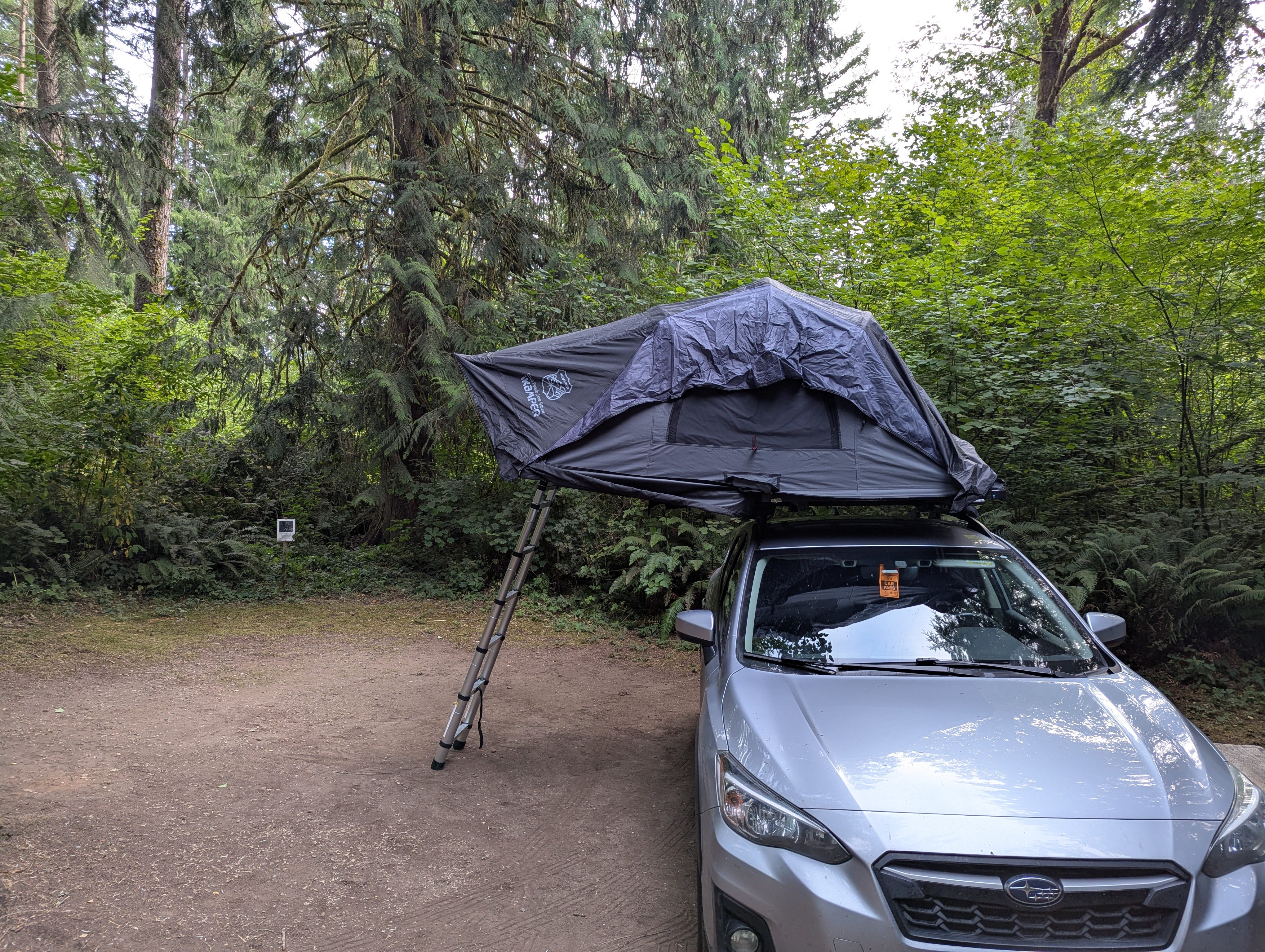
When you’re on an author-subsidized book tour, you find ways to save some dough. My iKamper X-Cover 3.0 helped with cost because I could roll up to any campground and ten minutes later be set up to sleep off the ground. Fun fact: RV parks are not much cheaper than a hotel and they don’t usually let you rent a tent site if you’re not putting a tent on the ground. [Ednote: iOverlander is a handy app for finding free dispersed campsites on public lands.]
A major advantage to the rooftop tent is being off the ground and on a queen-size mattress. It’s easier to set up than a ground tent in that it merely swings open. After setting up the rain fly with a few flexible metal poles, you’re ready to catch some Zs. The drawback compared to a ground tent is that you’d better be done with your adventures for the day because the last thing you want to do is pack the whole thing back up to make a beer (or marshmallow) run.
On a 29-degree night in Ketchum, Idaho, it kept me plenty warm. With the windows zipped and the waterproof rainfly providing extra insulation, I was cozy.
It retails for $2,695 at iKamper.com, but we were able to use a 20% off coupon at REI, whose employees helped install it on my car. I chose this model because we have a low garage door entrance and anything taller than 11 inches (closed) wouldn’t fit. It was less than half the cost of other brands, including some with aerodynamic hard cases. Other brands to consider are Thule, Yakima, and Tepui. —Brendan O’Meara
What’s On My Nightstand
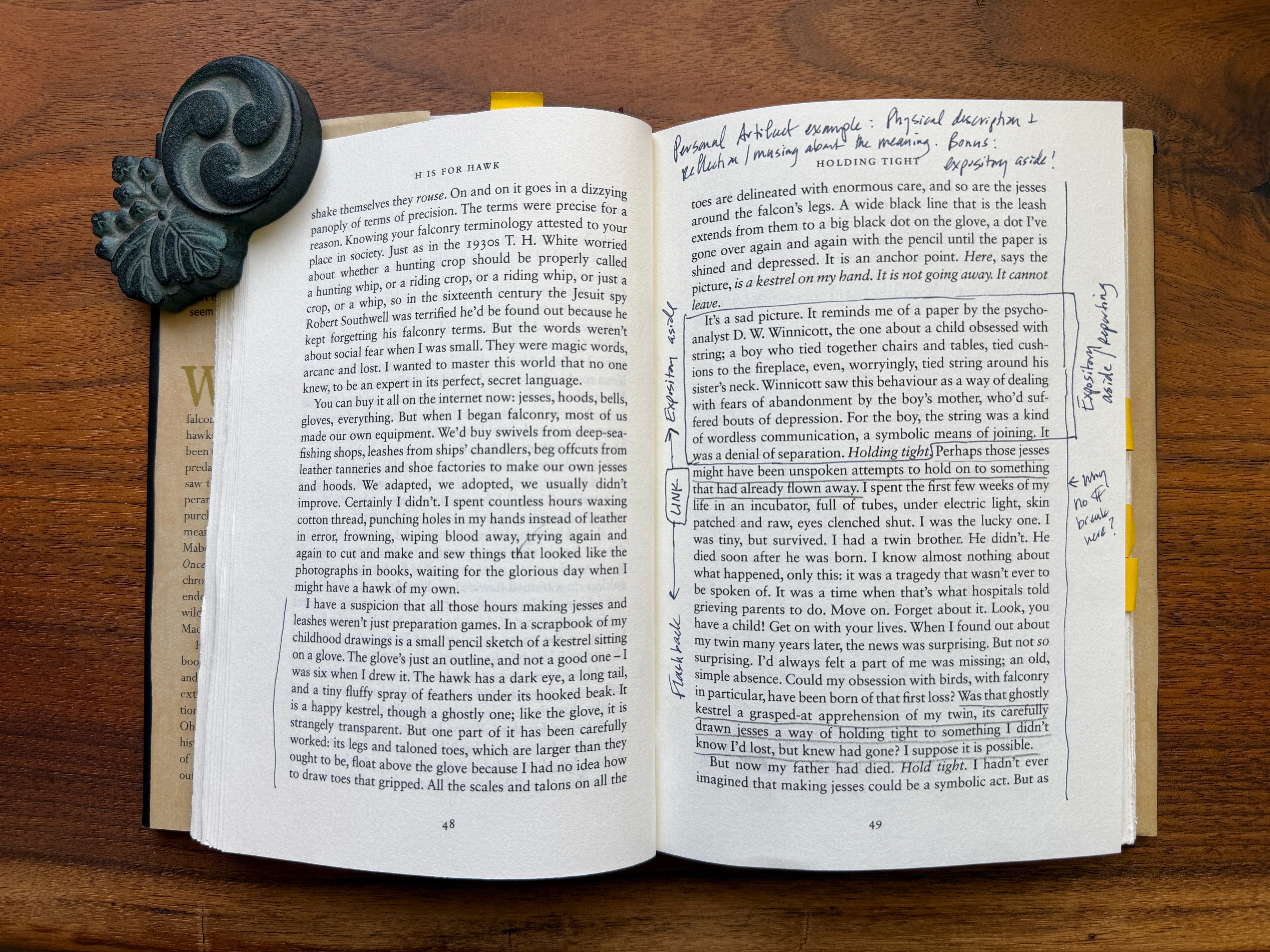
When H is for Hawk, by Helen Macdonald, came out in 2014, it won all sorts of critical acclaim: The Samuel Johnson Prize, Costa Book of the Year, a Sunday-Times bestseller, a New York Times bestseller, one of the New York Times Book Review’s 10 Best Books of the Year.
If you’ve not heard of this book—or the film adaptation released January 23—it’s a memoir about a woman who copes with her father’s sudden death by training a goshawk named Mabel in the ancient traditions of falconry.
Back in 2014, I couldn’t wait to read it. To my disappointment, I couldn’t finish it. I started and re-started the book three times, but I couldn’t get into the story. I didn’t see what all the buzz was about. Was there something seriously wrong with me?
Then, a couple of months ago—around the time my mother moved in with us after being diagnosed with Alzheimer’s—the book absolutely slayed me. Sometimes stories (the ones I’m writing as well as those I am reading) won’t let me in until they’re ready, or until the very moment I need them.
This go-around, I’m tearing the pages up with notes and underlined passages. This habit often corresponds with my teaching season. I’m ever hunting for examples of the literary techniques and narrative skills I’m trying to teach my students. Last week, a passage jumped out at me that I’d missed upon my first reading. Probably because it’s a model of the semester’s first graded writing assignment: The Personal Artifact. (Tip of the hat to Jacqui Banaszynski, who taught me this writing prompt.)
I’m also reading it closely to study its blend of memoir, science, nature writing, and a wisp of a biography of a falconer who died long before the author discovered his book as a child. I’ve been wrestling with eight years of research to write a book proposal for a story that crosses genres. I want to see how Macdonald weaves all of these different elements into a deeply personal, emotional journey that touches on something universal.
The book opened itself to me, I’m sure, because as I cared for my mother every day, watching dementia’s slow erosion of self and cognition, I was already actively mourning. Even though she was still alive, I had lost the mother who’d raised me.
Some of you may already know this from my posts on Instagram: A week before Christmas, my mother died suddenly and tragically from catastrophic injuries sustained in an accident in our home. It was horrific and traumatic.
I was already reading H is for Hawk and coping with my preemptive grief in my own unique way: river surfing. As a way to cope with chaos and uncertainty in turbulent times, I’ve been learning to surf a man-made wave on the Boise River. Every time I surf, I fall into a Class II whitewater rapid that tumbles me underwater like a rag doll in a washing machine.
I’ll share more about this next month. In the meantime, I want to thank everyone who has reached out with words of sympathy and comfort. I’m mostly okay most of the time. In the intermittent moments of really-not-okayness, I’ve learned, as the river has taught me, to surrender to the hydraulic and nonlinear forces of grief.
What’s New

One of my favorite nonprofits in Boise, the Learning Lab provides free, individualized instruction for adults, kids, and families who are learning English, earning a GED, working toward citizenship, and otherwise improving their reading and math skills. Last year, 305 volunteers served 490 students and 91 families.
This month, I have the great honor of being the keynote speaker for their biggest annual fundraiser, the Lunch for Literacy. I’ll be giving one of my all-time favorite talks about What Stands in a Storm, which was a community-wide read in two states and has been studied in high school and college classes in California, New Jersey, Ohio, Alabama, Georgia, and Idaho.
What’s Next
I’ve been enjoying my six-month tenure as Boise City Writer-in-Residence. This month, 45 writers showed up for our workshop on Dialogue (we needed more tables!)
If you’re in Boise, these are free writing workshops open to the public. Writers of all stripes and levels are welcome. Huge thanks to The Cabin, Boise Public Library, and the Boise City Department of Arts & History for organizing, funding, and promoting these community events.
Saturday, February 28: Story Structure
Learn how the deliberate sequence of revelation—what writers reveal to the reader, and when—shapes a story’s impact.
12-2 pm at the Library! at Cole & Ustick
Thursday, March 12: Pitching and Getting Published
Learn how to pitch your stories to editors and publications.
6-7:30 pm at the Library! at Hillcrest
Boise Writers! This is a wonderful PAID opportunity with a generous stipend. It’s a great way to connect with other writers and give back to your community. For more info on how to apply, connect with The Cabin.
Kim’s Whims
If you live in Boise (or happen to be passing through), I beseech thee to visit Oldspeak, a Book Beer Bar in Garden City. If a speakeasy and an indie book shop had a love child, it would be Oldspeak. (The name is a play on Newspeak, from George Orwell’s 1984.) It’s the Third Space of my dreams — a coffee shop by day, pub by night (with sexy NA options) — and they generously host Rough Draft, a quarterly happy hour I organize for nonfiction writers in Boise.
I begged them to let me be the “bookshop cat,” and they BOUGHT ME THIS ADORABLE ROLL-TOP DESK! Which I keep stocked with sweet treats, notecards, colored pencils, and other surprises for the curious. If you leave me a note, I’ll write you back! (Someone recently wrote a poem here… and it just got accepted for publication!) This micro-community brings me a macro amount of joy.
Brilliant breakdown of reconstructing interiority when the subject can't be interviewd. The part about mining archives and conflicting secondary sources really hits at the core challenge of posthumous biography. I've done similr work with historical figures and that tension between getting psychologically accurate without inventing is real. Pre's story became way more compelling once I understood the methodological challenge behind it.