

Watching the Olympic figure skating competitions this month stirred up long-dormant emotions and painful memories of battling pressure and fear as an athlete. Watching “Quad God” Ilia Malinin choke under the weight of the world’s expectations put tears in my eyes and an ache in my heart. Seeing Alysa Liu skate for joy—winning gold as a happy side effect—reminded me of lessons I learned from a decade of disappointment.
I never achieved my childhood dream of making the US Team. (My sport is not an Olympic sport, though it does have a World Championship.) I want to share what it feels like to choke under pressure, in a moment you’ve spent years training for. How one failure can get into your head and infect your confidence. And how, through trial and copious error, I learned to break the pattern with a sequence of mental skills. Many of these skills apply to life beyond sports. I hope you find them useful.
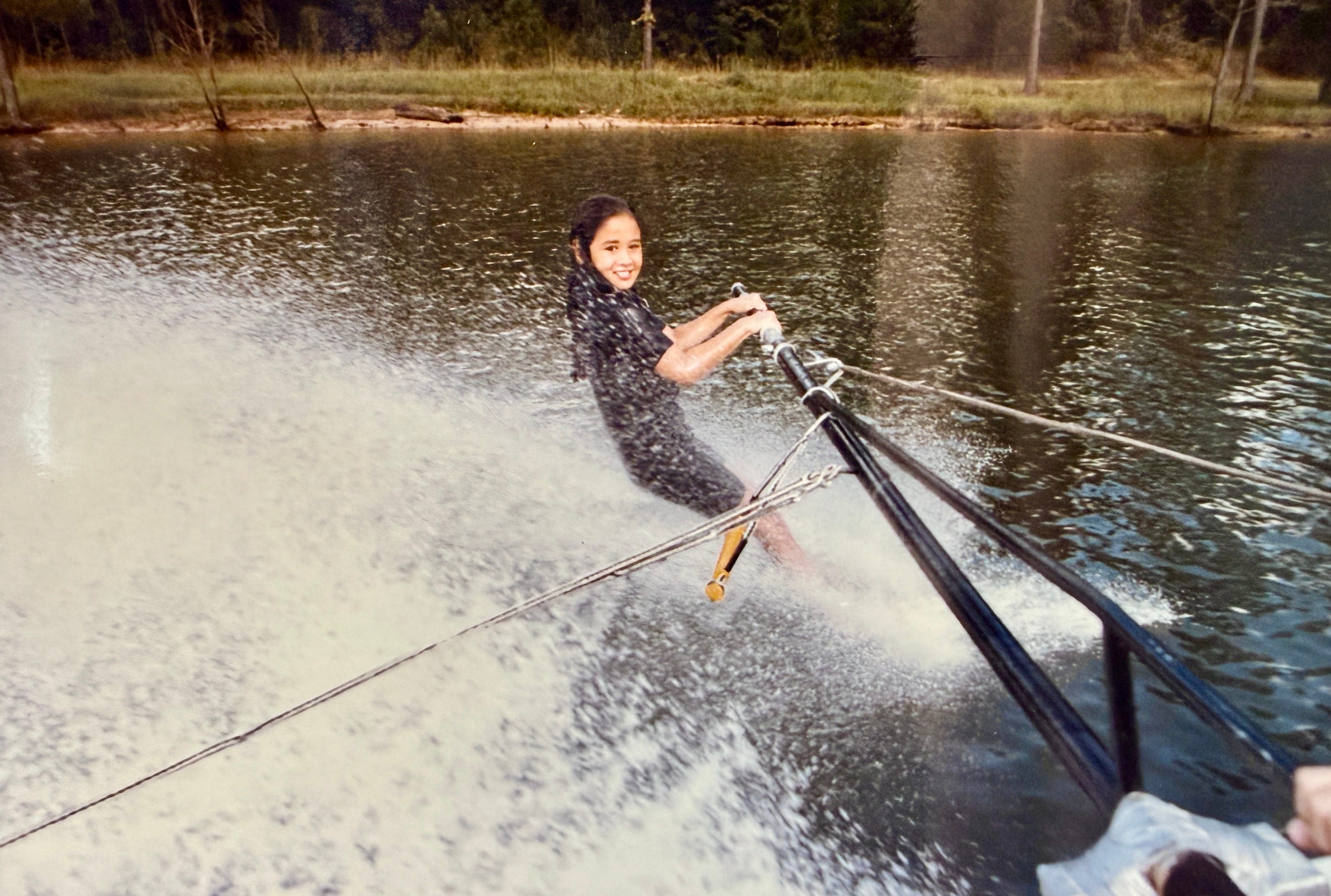
My story begins on a catfish pond in a podunk town called Ozark, Alabama. I was nine when I learned to water-ski on that muddy pond. It had a slalom course with buoys the size of my head, a jump that rose five feet from the water, and occasional water moccasins. I spent the best days of my childhood here, training with three older boys who came to feel like brothers. We shared a ski boat with a perfect wake: small at high speeds for slalom and jump, big and crisp at slow speeds for trick skiing.
At first, it was all about joy and fun. Between practice sets, we’d have seaweed fights and slam-dunk each other like Hulk Hogan and Andre the Giant. We messed around on kneeboards, learned to barefoot, and did at least one pyramid.
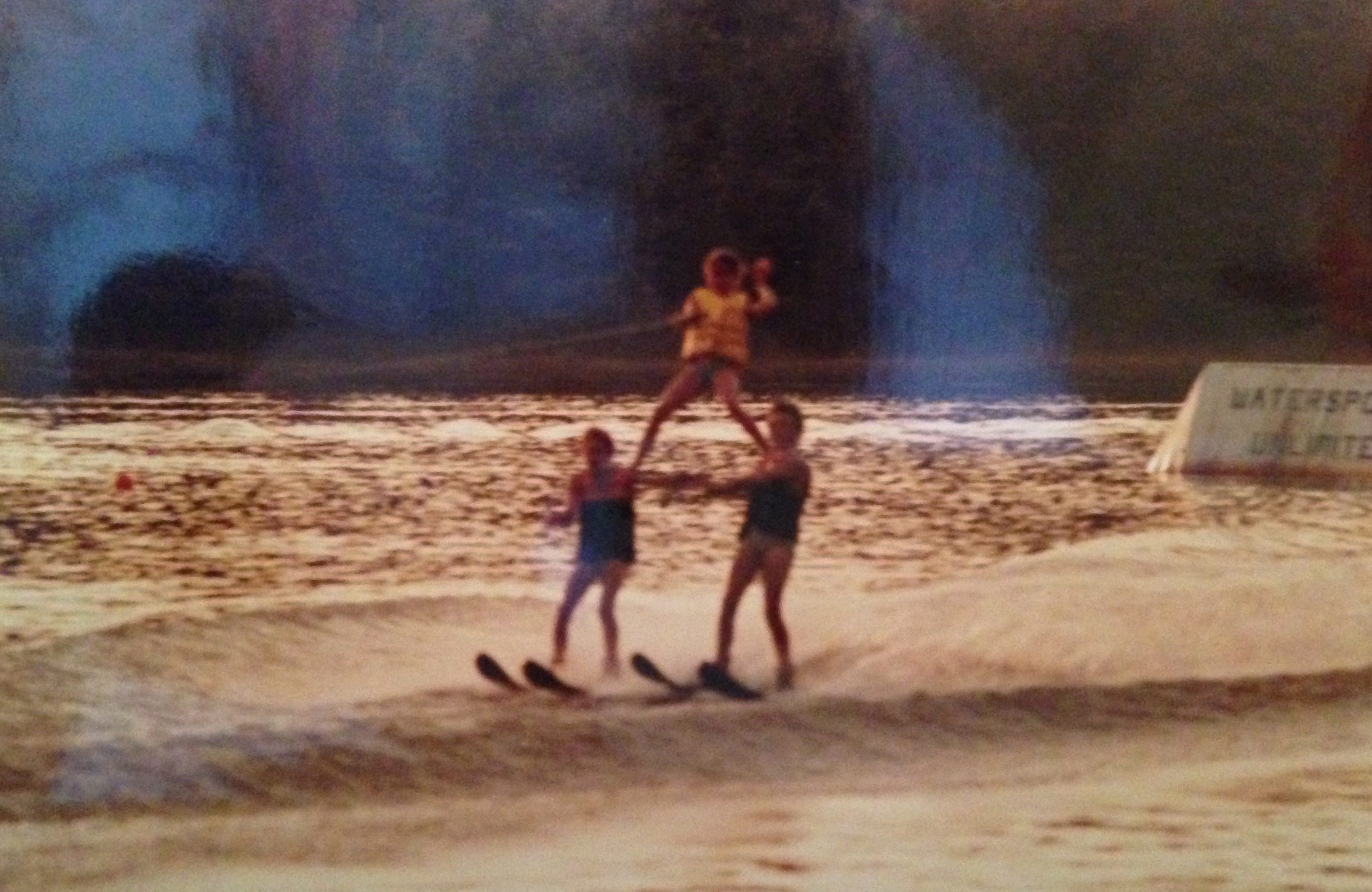
In 1985 I entered a tournament “just for fun.” I went up against two Junior Girl national champions who later went pro. I carved arcs of spray around six bouys, starting at the minimum speed of 24 mph. With each successful pass through the slalom course, the boat speed increased, up to 34 mph (36 mph for men). Then the rope started getting shorter. You made up for lost rope by letting go of one hand and stretching your body to the buoy line.
I’m pretty sure I came in dead last. But I was happy because my expectations were low. I just wanted to run my opening pass.
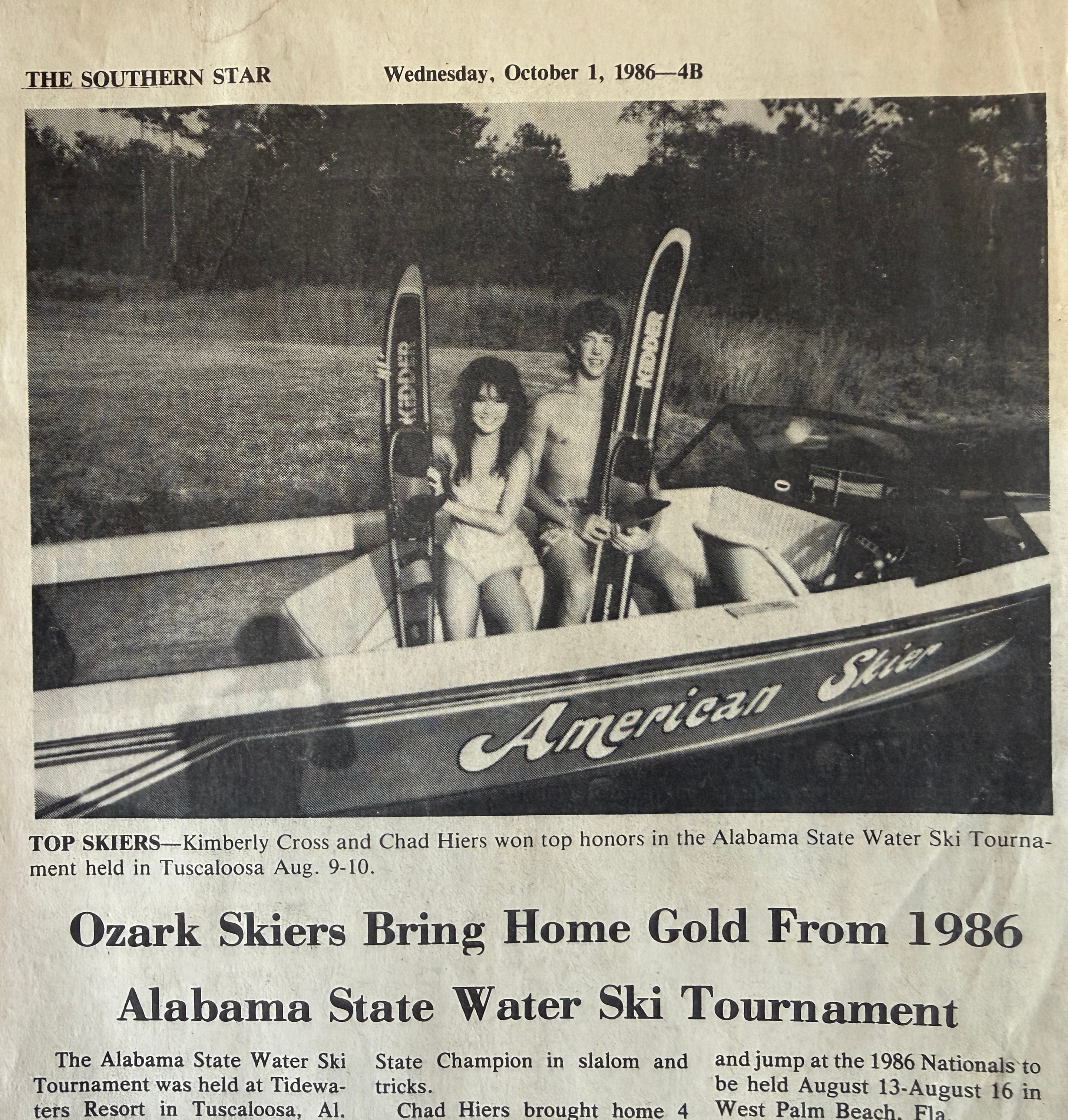
The next year, at 10, I won the Alabama State Championships, a fact I had forgotten until I found this newspaper clip. I may have been the only one in my division, or one of two or three Junior Girls. Considering my winning score—6 buoys at 28 mph—the competition wasn’t too stout.
When I was 12, I qualified for Nationals. Based on my scores in other tournaments, I was ranked No. 2, which meant I skied next-to-last and had a very good shot at the podium. This was the first time I remember feeling the pressure of expectations.
It was the year we moved to California, where reservoirs prohibited motor boats. I was limited to training three months a year at a ski school in the Mojave Desert. From the ages of 12 to 15, I spent summers living 200 miles away from my parents at the first man-made ski lake in the world, located somewhere between L.A. and Las Vegas, 20 miles from the nearest town.
Nationals were in Zachary, Louisiana. On the starting dock, nerves manifested as nausea, flopping around my gut like hungover butterflies. My legs felt weak, like my knees might buckle. I kept yawning—I sign I was forgetting to breathe. The big sister of one competitor said something to me that “psyched me out.” My head festered with self-doubt. I just wanted it to be over.
As the boat took off, the water felt warm and soft, smelled faintly of mud, and tasted sweeter than the water out west. As I made my first cut, I felt like the boat was going too slow. The wake felt mushy under my legs, which felt like overcooked pasta. My timing was off, and as I entered the gate, my ski tagged a buoy. I spent the next six turns and 16.08 seconds praying no one would notice.
Of course the judges noticed. Hitting a gate buoy meant instant disqualification. A zero score. On the ride of shame back to the dock, I hung my head, already crying, feeling the burning of everyone’s eyes on my face.
My zero score in the slalom event meant I was also disqualified from Overall, the category for three-event skiers who also competed in tricks and jump.
I cried for four hours, until my eyes swelled shut. Failure felt like a fever, a whole-body ache that wouldn’t go away. I wanted to crawl out of my skin or lock myself in a dark closet. I hated myself for disappointing my coaches and letting my parents down. All that money and time for nothing. Weighty feelings for a twelve-year-old kid. My heart still bears the scars.
Four years of training had produced the physical skill to be competitive. But I didn’t know—wouldn’t know for years—that in the absence of mental skills, world-class physical skills can (and will) fail under pressure. Athletes must train their minds as deliberately as they train their bodies.
Every failure eroded my confidence and reinforced the pattern.
I was prisoner to the love-child of a self-fulfilling prophecy
and a positive (reinforcing) feedback loop.
When I sixteen, we moved to Florida, where I’d wake at dawn to train before school on my backyard bayou. After school, I’d drive 45 minutes to a private lake with a world-class ski school. I got a job there driving the boat, washing dishes, cleaning the toilet, and coaching beginners to pay for my summer training—three to five sets a day, five to seven days a week.
I learned to adjust to changing conditions: headwinds, tailwinds, crosswinds, “nervous” water, the difference between “fast” and “slow” water (a key factor at my first Nationals). I found that if I felt confident, I could perform in competition at the same level I could in practice. But at bigger tournaments, I often fell short. The weak knees. The sudden lack of coordination. Why wouldn’t my body do what I’d trained it to do in practice?
Every time I choked in competition, it added to the fear and doubt I’d fight at the subsequent tournament. Every failure eroded my confidence and reinforced the pattern. I was prisoner to the love-child of a self-fulfilling prophecy and a positive (reinforcing) feedback loop. It felt like swimming against an undertow.
My dad eventually quit coming to tournaments. He said he thought his presence made me nervous. I believe he was tired of sitting around all day, only to watch me choke.
It wasn’t until college that I learned some mental skills that broke the choking pattern. I don’t recall where I learned this stuff. But if I did certain things—the same way, in the same sequence—I could perform under pressure. Consistently. The year I developed my sequence, I ran 2 at 35 off—a level I rarely exceeded in practice—almost every single tournament. At Nationals, due to a slow boat speed, I had to do it twice in a row. It was enough to claim the national title—and qualify to go pro.
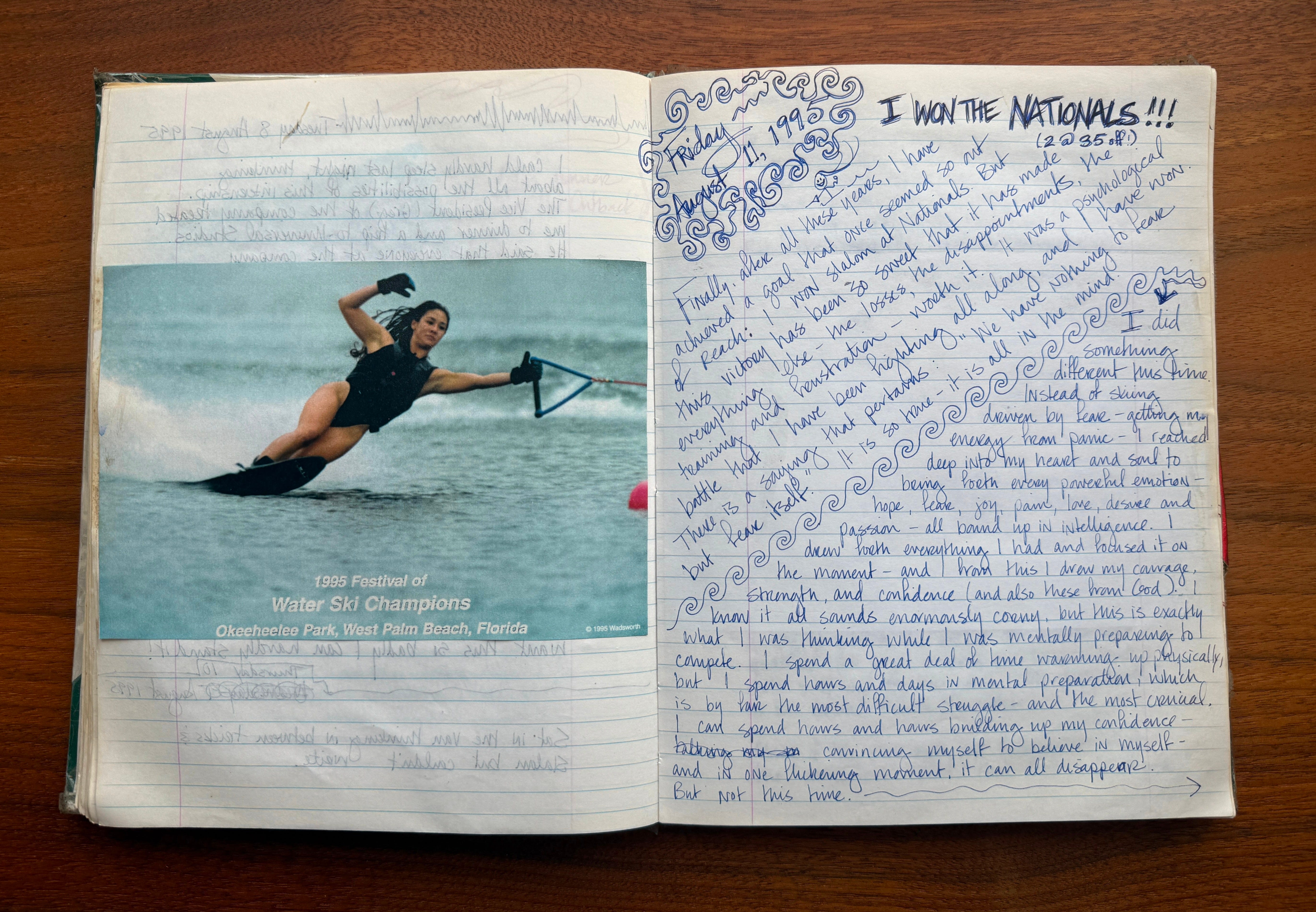
“It was a psychological battle…” my younger-self wrote in my journal. “There is a saying that pertains: ‘We have nothing to fear but fear itself.’ It’s so true—it is all in the mind.”
(Older-self: It’s also in your body. Read “Pressure Is Not Just In Your Head,” by Sally Jenkins of The Atlantic to learn the physiology and neurology of choking.)
The Mental Skills that Broke the Choke
Feeling I’d finally cracked the code, but worried I would forget it, I recorded the mental sequence in my journal. Here’s the gist (with some edits for clarity):
Wake up at least 2 hours before competition. (It takes your body 2 hours to fully wake up.)
Eat breakfast. Always the same thing. (Honey Nut Cheerios with 2% milk.)
Warm up with light movement/stretches. Always in the same sequence.
Walk the lake and study the course. Note the boat path out of the turn island. Look for stray buoys that might cause errors in lining up for the gate.
Get your mind in gear. Avoid socializing. Go to a quiet place away from people to focus. Put on headphones and listen to music (always the same psych-up album) to signal to the mind and body it’s time to compete. (Headphones signal: Please don’t talk to me now.)
Tie your ski handle to a tree and lean like you’re pulling across the wake. Or let Mom hold the rope and practice your trick run on dry land.
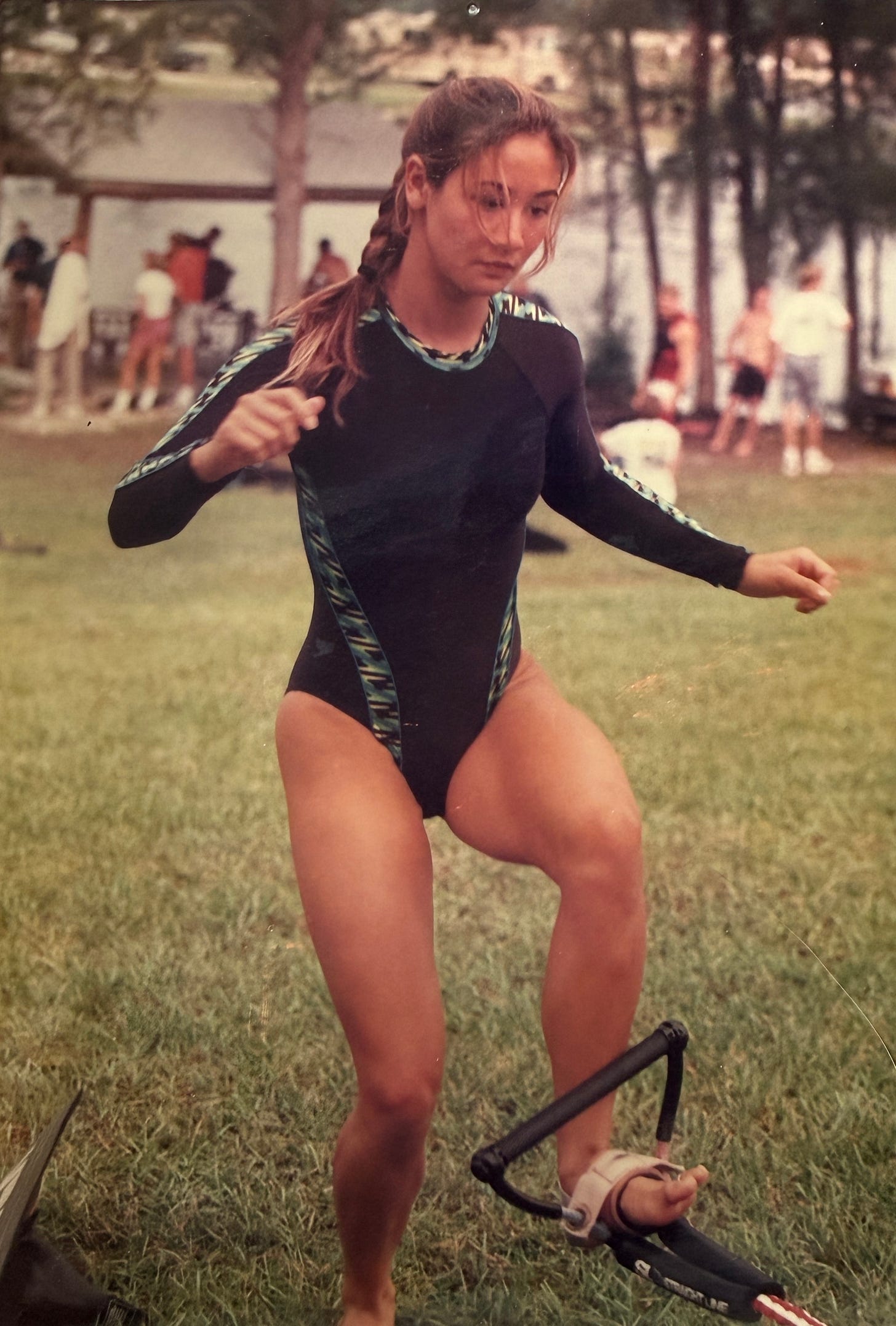
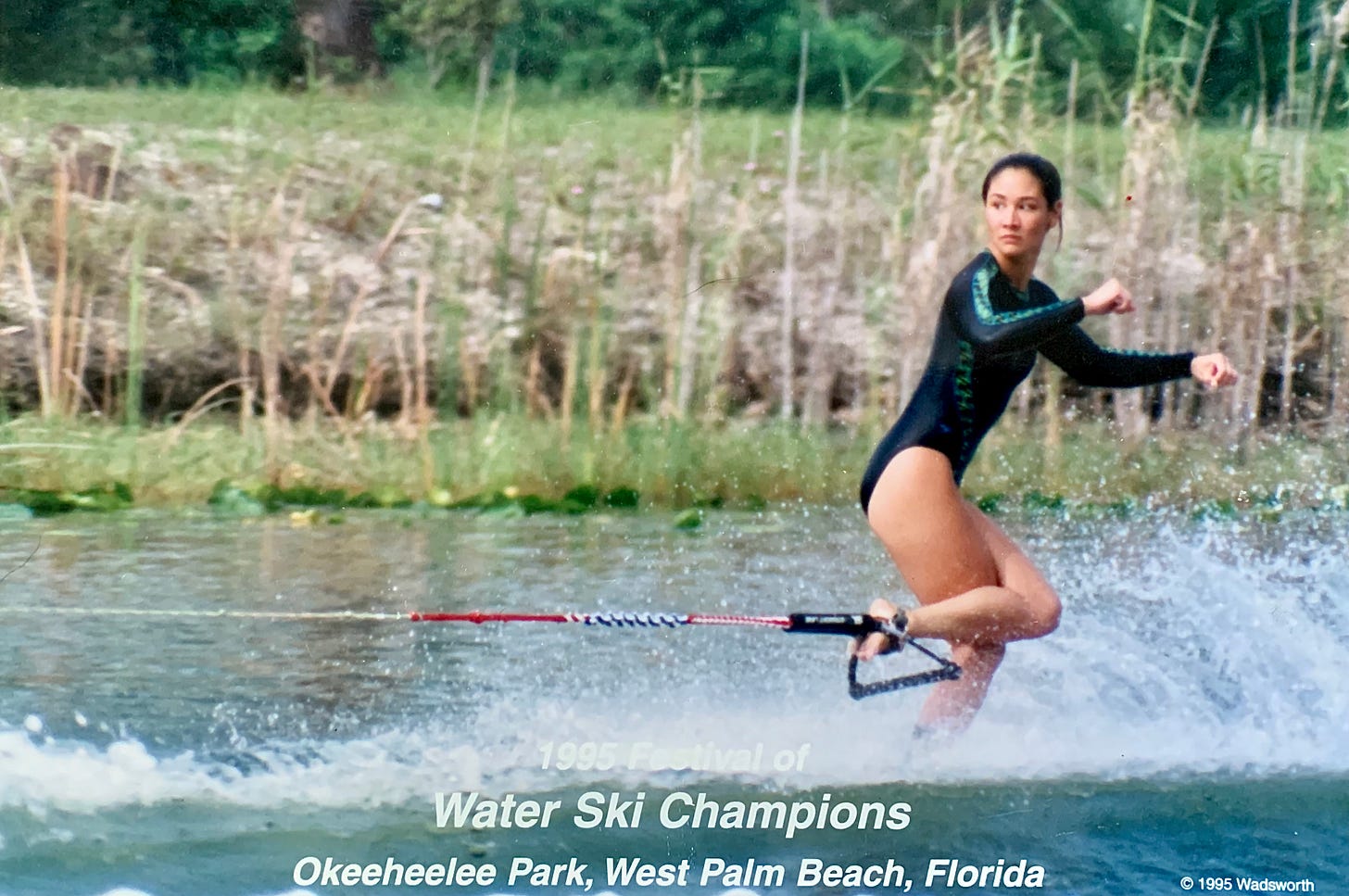
Visualize. Envision a solid performance. Nothing heroic. Just the same thing you do every day in practice.
Breathe deeply from stomach (shoos away butterflies). In through nose, out through mouth. If you’re yawning, it means you’re shallow-breathing.
If your mind is racing, read a book. Don’t think about your competitors. Focus your attention on what you can control. Don’t worry about what you can’t.
Repeat your mantra: Strength. Courage. Confidence.
In the water between sets, don’t let the boat rush you. When they ask, “Are you ready?” Say “Just a sec.” Take three deep breaths, then say, “I’m ready!”
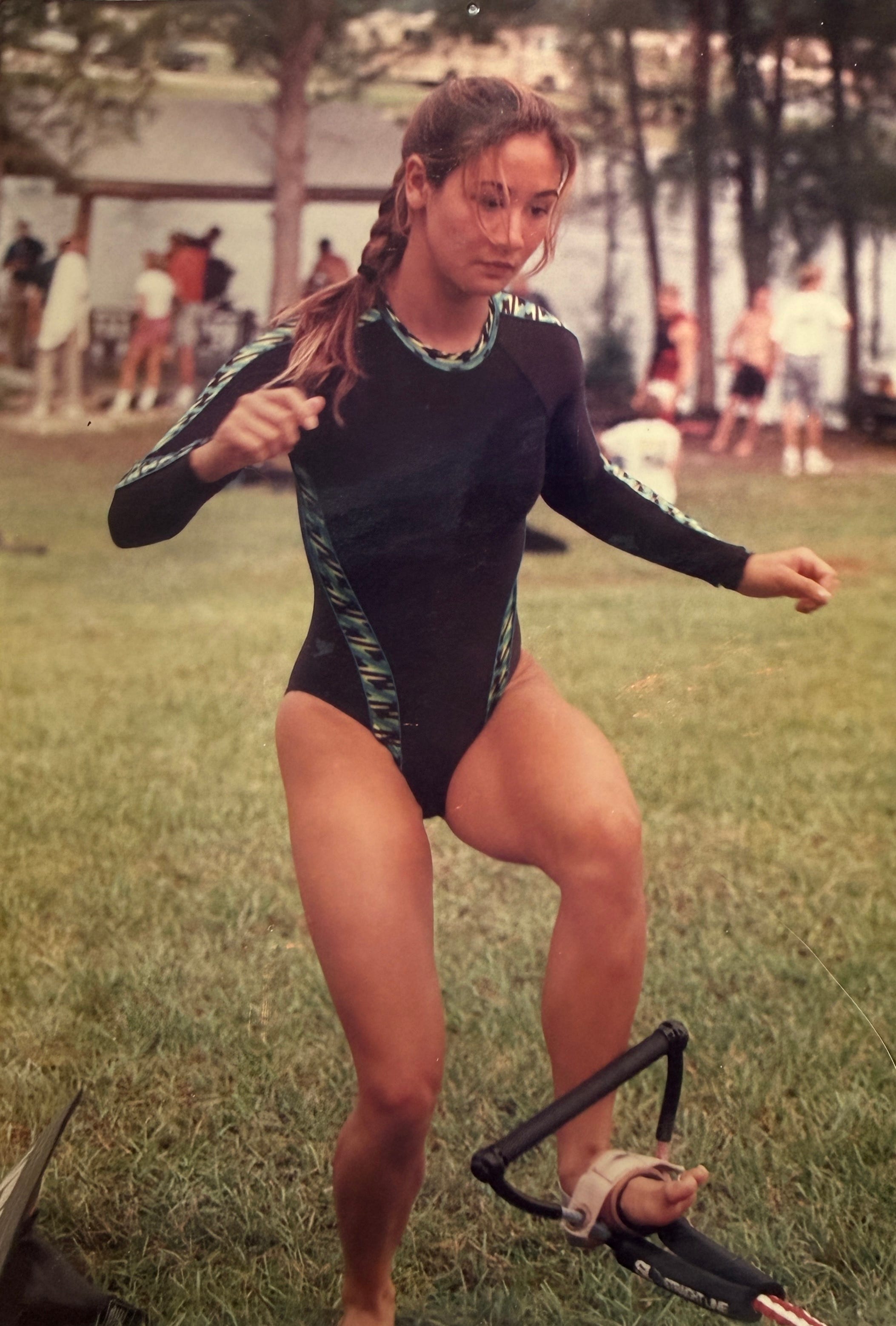
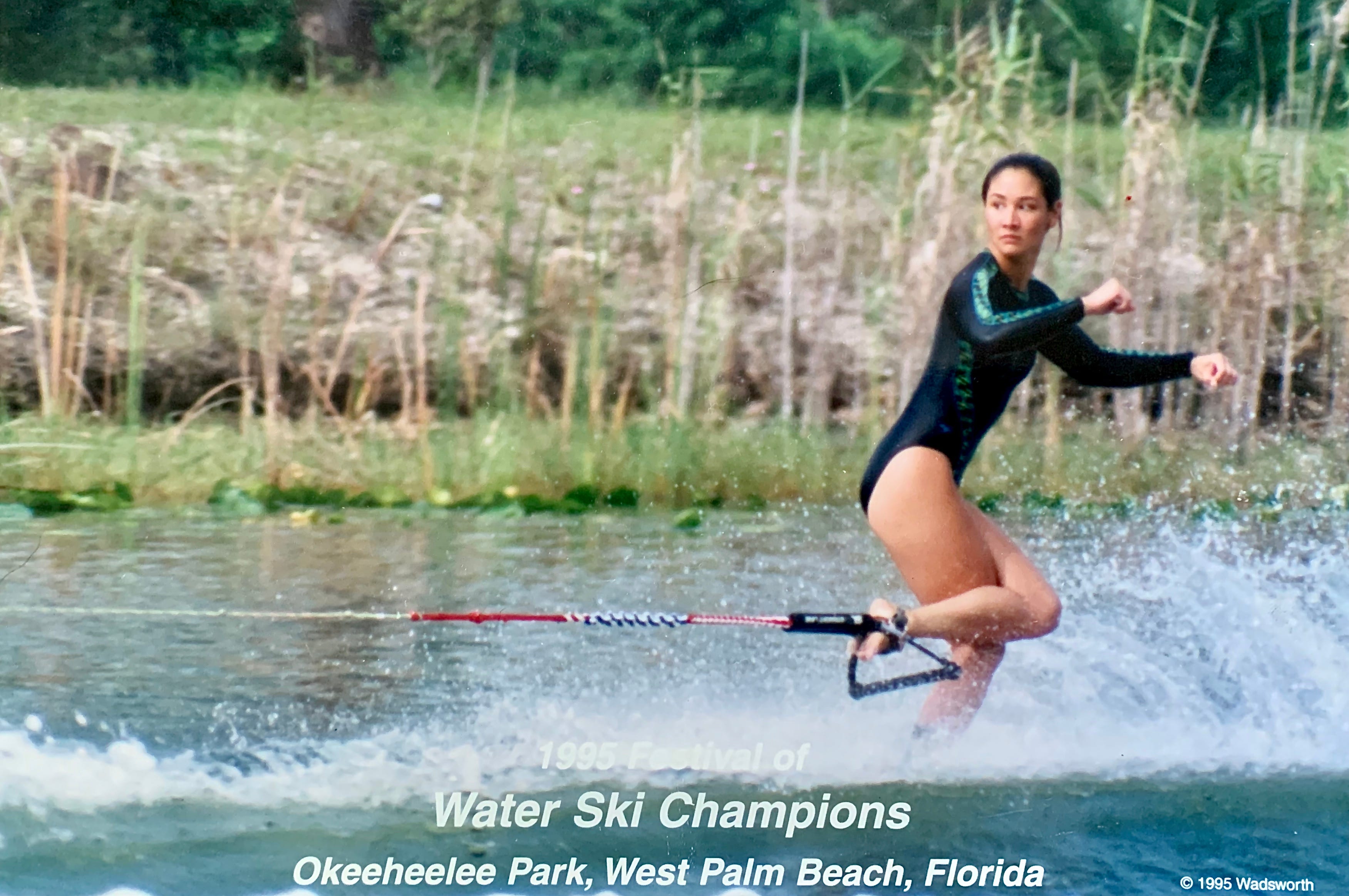
At the time, this all felt like a weird and slightly embarrassing mix of cheesy rituals and woo-woo superstitions, seasoned with a pinch of placebo effect and a dash of prayer. I believed it was my own idiosyncratic way of dealing with pressure. I had to do part of my sequence in public, but I did as much as possible out of sight. I didn’t like talking about it. I feared people would laugh and make fun of all my weird and cringey rituals.
A few years ago, while interviewing a sports psychologist, I learned my secret rituals were not just “my thing” but A Thing. A near-universal suite of mental skills and tools, employed by elite athletes in every sport. And also by people in high-pressure roles that have nothing to do with sports.
The Science Behind the Skills
The sports psychologist was Dr. Craig Manning, whose master’s thesis examined the attributes of high-performing athletes across all sports. He’d use his findings to coach tennis teams, Olympic skiers, Red Bull athletes, and pros in the NFL, NBA, and NHL. His book, The Fearless Mind, explains all of the mental skills I’d cobbled together through trial and error. He laid out a framework, a better vocabulary, and backed it all up with science.
These mental skills would help pro mountain biker Braydon Bringhurst do something that had never been done, something experts thought was impossible: Ride his mountain bike UP the Whole Enchilada, a world-famous downhill trail in Moab, Utah. He wanted to pedal up every inch, including The Snotch, a slab of sandstone as steep as a playground slide. This quest was The Dawn Wall of mountain biking.
Braydon hired me to write his documentary, 8600 FT, which tells the story of how he trained, prepared, and struggled through the day of the climb. Even if mountain biking’s not your jam, it’s hard not to feel a rush of inspiration watching the 90-minute film on YouTube, which has 1.2 million views. For more details on the mental skills, you can read the Bicycling magazine story: Braydon Bringhurst vs The Beast.
I recommend The Fearless Mind to the athletes I coach through Flow State. I also recommend The Inner Game of Tennis, one of the first popular sports-psychology books, a classic since the 1980s. It shares tactics for overcoming nerves and self-doubt by getting your mind to relax so your body can do what you’ve trained it to do. For a more recent take on the prefrontal cortex, listen to this NPR/TED Radio story about the cognitive science of why we choke under pressure.
You don’t need to be an athlete to flex these mental skills. Dr. Manning now coaches CEOs and leads corporate training seminars. Last week, I had to deliver a keynote speech to a ballroom of 800 people, the biggest audience I’ve ever addressed. Before going onstage, I found myself unusually nervous and shaky. I snuck into a back room, did 30 push-ups, and repeated my 30-year-old mental sequence. It still works!
Prioritizing Joy Over Performance
As I watched the Winter Games, Alysa Liu’s story of burning out and coming back—on her own terms—made me want to leap out of my chair and scream YES! THIS!
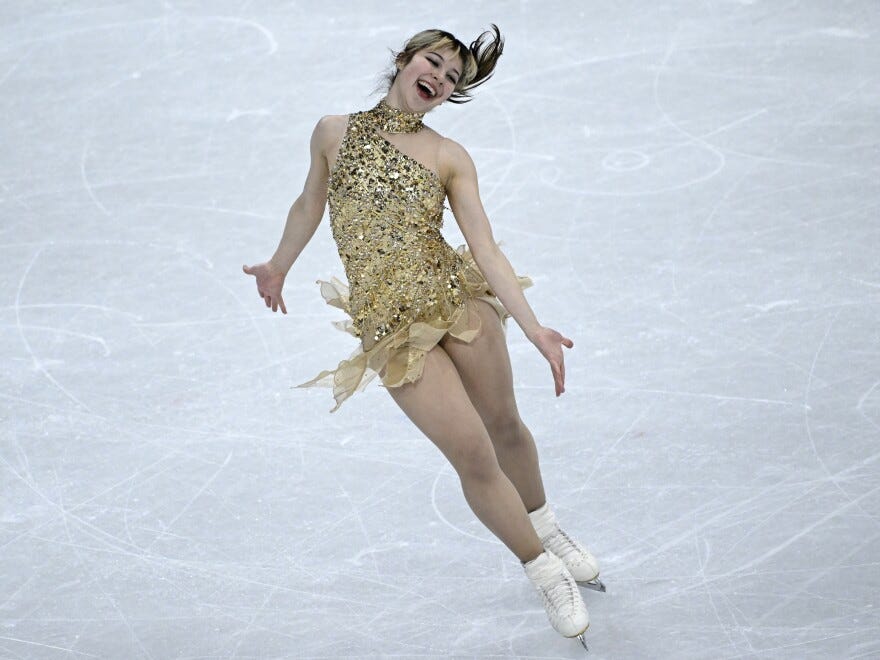
The risk of burnout is high for elite athletes striving for greatness in any sport. Being great requires discipline. Self control. Sacrifice. Pushing beyond your comfort zone. Learning to live in the pain cave. Falling. Failing—over and over. Without getting too discouraged.
Yet the nature of sports is that no amount of suffering, preparation, skill, and confidence can guarantee a good outcome. You can do everything right, and in competition, some factor—often outside your control—can cause it all to unravel. The harder you work, the higher the stakes, and the harder the disappointments. The worst thing that can come of it? Losing your love for the sport.
Skating came to feel like a job for Liu, whose father controlled almost every aspect of her training and career. After a disappointing performance at the 2022 Beijing Games, she announced—without telling her father first—she was retiring from the sport. She was sixteen years old.
Years later, skating for fun with friends, she felt a spark of joy that reignited her love for the sport. She announced she would return to competition, but she would now be in charge. She would pick her own music. Choose what she wore. Decide when she needed to train harder or back off and prioritize rest. And by golly, she would eat lava cake whenever she damn well pleased.
“No one’s going to starve me,” she said. “Or tell me what I can and can’t eat.”
That quote made me think of my first Nationals and the twelve-year-old girl who won. A few years later, she vanished from the sport. I always wondered why. We bumped into each other as young adults, and she told me about her struggle with anorexia. “It was the only thing I felt I could control,” she said.
The other thing about Liu’s story that hit home? Joy. The key word in the headlines, the emotion exuded in every frame. She wasn’t skating for gold. She was skating for joy. Winning a gold medal was awesome, but it wasn’t her main objective.
“I don’t NEED this,” she said of her medal. “What I needed was the stage, and I got that, so I was all good no matter what happened… If I fell on every jump, I would still be wearing this dress.”
Reading that strummed some long-silent chord. I dug out my 30-year-old notebook to fact-check my ancient memories. “I’ve never seen that before,” my husband said.
I’ve only shown it to three people. My teenage son, as he prepped for mountain-bike Nationals this year, and two teenage girls who compete at the national or world level in road racing and cyclocross. I thought they should hear it from a teenage athlete, not some preachy middle-aged coach.
“I did something different this time,” wrote my 19-year-old self. “Instead of skiing driven by fear—getting my energy from panic—I reached deep into my heart and soul to bring forth every powerful emotion—hope, fear, joy, pain, love, desire, and passion…and focused it on the moment.”
Joy and focus on the the present. Key ingredients in the secret sauce. I just want this to be over, I used to think. My mindset switch that changed everything: I’m grateful to be here, doing what I love, and I want this moment to last forever.
Even after I cracked my mental code, I didn’t always nail my performance. I underperformed at every US Team Trial and never went pro. I retired at 23. Fifteen years later, after training harder and than ever for the off-road triathlon world championships, I finished DFL (Dead Frickin’ Last).
“I have learned all my best life lessons through sports,” I wrote in The Art of Losing, a story for ESPN. “How to suffer. What to sacrifice. When to compromise. Why teamwork matters. That falling is an art. And that sometimes, what you learn from losing can be even sweeter than winning.”
As a lifelong athlete in more than 10 sports, I’ve lost WAY more often than I’ve won. It forged a joyful tenacity, a deep respect for process, and an ability to fail repeatedly without getting too discouraged. I no longer feel much desire to compete, but learning new things still thrills me. What keeps me going is chasing the joy I found on the water as a nine-year-old kid.
Thanks Laura. What does battling pressure of chasing joy look like in your life?
Beautiful story, Kim, and whooooooo boy can I relate!