

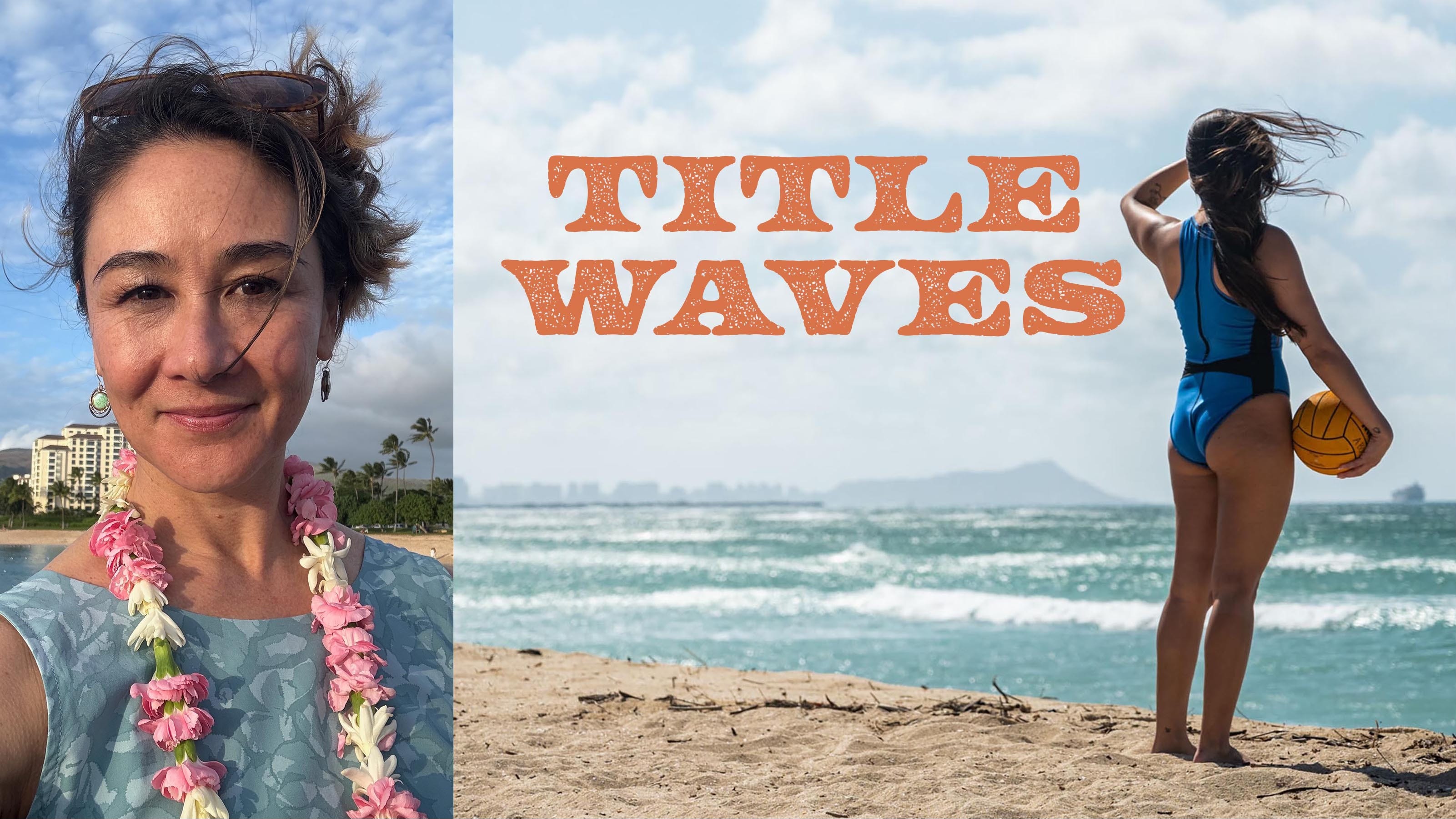
One of my favorite things about being a journalist is that I never stop learning. Often I have to start from scratch. Before writing In Light of All Darkness, I’d read only one true crime book (In Cold Blood, by Truman Capote). When I was approached to write The Stahl House, I’d never heard of the Case Study House Program. When I started reporting What Stands in a Storm, I read children’s books on tornadoes before interviewing the first meteorologist.
Other times, I diver deeper on a subject I know something about. My latest longform narrative, Title Waves, tells the story of a landmark Title IX case in Hawaii. As a lifelong athlete and journalist who frequently covers the fight for equity in women’s sports, I thought I knew a thing or two about Title IX and women’s rights.
How wrong I was. Among the many things I learned in six months of reporting was the depths of my own ignorance.
My first revelation was that the principal author of Title IX, Hawaii Representative Patsy Mink, was the first woman of color elected to Congress. Like my mother, she was Japanese American and had lived through the Anti-Japanese propaganda of World War II.
Born on Maui, Patsy was a girl who wondered why teachers laughed at her dream of becoming a doctor. In high school, she was voted class president and valedictorian, but when she applied to at least 10 medical schools, all of them rejected her. She pivoted to law, school but no firm in Hawaii would hire her. So she became a politician and worked to change the system that had impeded her.
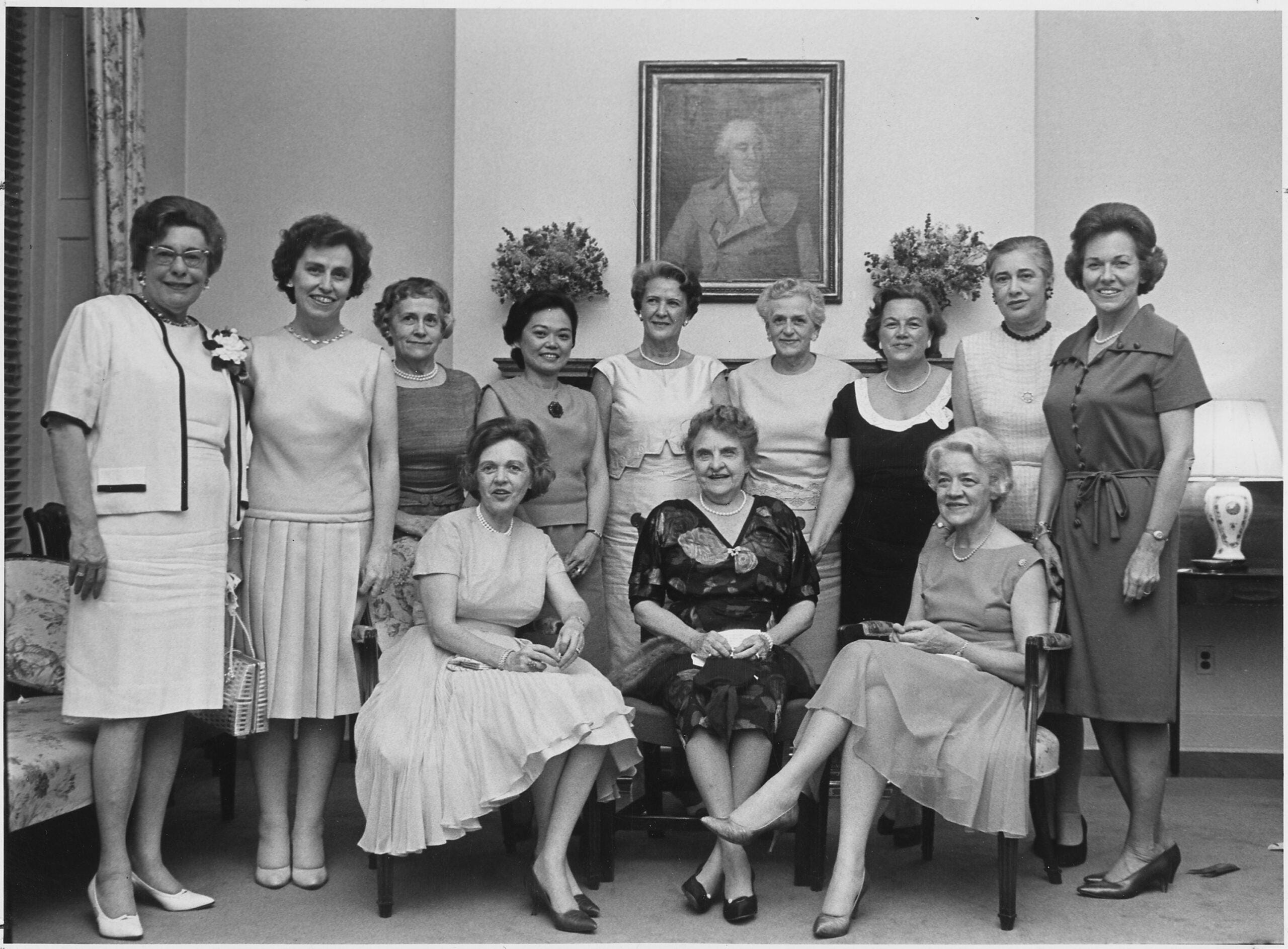
With Edith Green, a representative from Oregon who championed women’s rights, Patsy co-authored Title IX, one of the strongest and most enduring laws protecting women’s rights. Its 37 words are a testament to the power of elegant brevity:
No person in the United States shall, on the basis of sex, be excluded from participation in, be denied the benefits of, or be subjected to discrimination under any education program or activity receiving Federal financial assistance.
After passing in Congress with bipartisan support, Title IX was signed into law on June 23, 1972, with little friction or fanfare. But when it came time to enforce the law with regulations in 1975, controversy erupted over whether the clause “any educational program or activity” applied to women’s sports.
Fearing any gains for women’s athletics would come at the cost of men’s sports, some lawmakers tried to amend Title IX to exclude sports. Patsy Mink had to fight to keep her law from being gutted. The tide turned… and turned again, and her law kept its teeth.
Naively, I presumed that most schools today are more or less in compliance with Title IX. Because breaking a law has consequences… right?
I was shocked to learn that around 90 percent of high schools and colleges are not in compliance. And even more astonished to learn the enforcement mechanism behind Title IX—the withdrawal of federal funds—has never been triggered. Not once. In more than half a century.
And I was stunned to learn that enforcement of Title IX falls largely on the shoulders of women or girls and their parents. This means they have to know their legal rights and stand up to what’s likely the most powerful institution in their young lives: their school.
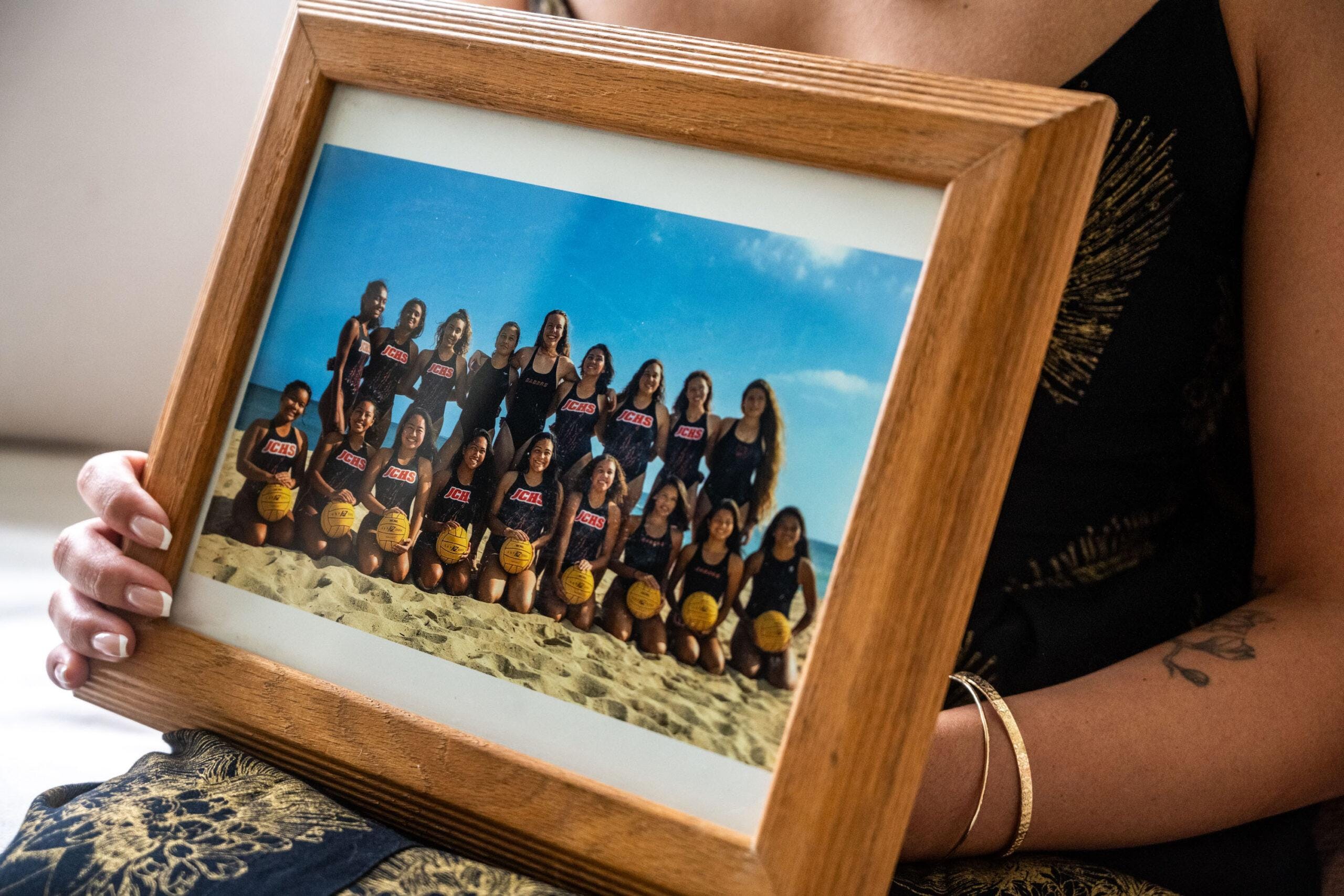
Ashley Badis, one of the underage plaintiffs in AB v Hawaii DOE, was fortunate to have parents who paid attention and did the legwork to learn her rights under Title IX. Through perseverance and a bit of luck, they connected with the ACLU, which represented the girls in the landmark case.
Did I know my rights in high school? Nope! Did we even have a girls’ locker room? I couldn’t remember, so I found my soccer teammates on Facebook and asked them.
“We didn’t have a locker room except when it was super cold or raining, we were allowed to go into the visitor’s locker room under the stands,” said our goalie, Leslie Vincent. “And I remember twice going into the field house cause it was eye-opening the amenities it had.”
I’m pretty sure my first exposure to Title IX was a Title 9 clothing catalog. Even if I had known my rights, I wouldn’t have known how to fight for them.
Before reporting Title Waves, I didn’t know that the federal government has an agency to enforce civil rights laws like Title IX: the Office of Civil Rights (OCR). Created in 1979, the OCR is part of the DOE and exists to stop educational institutions that receive federal funds from discriminating on the basis of sex, race, or disability.
The OCR is legally mandated to resolve 80% of complaints within 180 days, but it has struggled to do so for more than a decade. The volume of complaints has more than doubled since 2015, and the staff hasn’t grown accordingly.
Then, in March 2025, the OCR staff was reduced by half. Those who didn’t lose their jobs went from handling dozens of cases to hundreds.
“They’re being asked to do the impossible,” says Linda Mangel, a former director of enforcement who worked at the OCR for 15 years. “Before March 2025, OCR staffing was already stretched beyond capacity to promptly resolve complaints; now it is altogether broken.”
Moreover, last year an executive order explicitly directed the remaining OCR staff to prioritize punishing schools that allow transgender athletes to participate in women’s sports. Traditional athletics equity complaints have been sent to the back of a queue that’s getting longer and moving more slowly.
That means the only realistic means for timely enforcement is a lawsuit. And the one in this story — AB vs Hawaii DOE — took six years to resolve. By the time a settlement was reached, the plaintiffs were in college or working. They didn’t get to personally enjoy the changes they won.
But they made things better for generations of girls who’ll follow. They embodied one of the most important lessons sports can teach us: Sometimes you have to take one for the team.
If you want to hear more of the story behind the story, you can listen to me talk about it on Hawaii Public Radio or read this Q&A with Depth Perception.
I’d be grateful if you’d take time to read the story and share it with women and girls (and also men and boys!) who support equal opportunity in education and sports. My hope is that this story can serve as a playbook that future girls and women can use to understand and fight for their rights.
My Stress Wood Theory
It’s no coincidence that the cast of advocates fighting for equity is almost entirely made of athletes, most (but not all) of them female. The lawyers, coaches, athletic directors, OCR enforcement directors, and Title IX athletic specialists in Tidal Waves are former or current athletes. Wookie Kim, the ACLU lawyer who represented Ashley in AB v Hawaii DOE, was a coxswain on the Yale crew team in college, and is now an ultra-runner who makes the podium in shorter races… while pushing his daughter in a baby jogger.
It’s no coincidence that the most tenacious Title IX advocates were and are athletes. Sports teach skills that serve outside of sports. How to be uncomfortable. Why teamwork matters. How to lose. How to fall — and get back up. When to fight. How to take one for the team. We often have more to learn from losing than from winning.
But what about the pushback? The retaliation? It feels pretty awful when it’s happening, especially when it’s unfair. Aside from the fact that the world isn’t fair, and remained largely stacked against women, what do those negative forces have to teach us?
I offer you here my Stress Wood Theory. Scientifically known as “reaction wood,” stress wood is a special type of wood that forms only in trees that grow and thrive in areas with high winds. It’s stronger, more resilient, more tensile than ordinary wood.
Throughout history, there appears to be an interesting pattern. Many women who stood up for themselves paid a terrible price: pushback, retaliation, shaming, scorn, trolls, ostracism, criticism for being “too strong.”
But many of them have gone on to be exceptionally successful in board rooms, courtrooms, politics, and leadership role in other male-dominated professional realm. Years later, you can often find them advocating for women in some other role—coach, athletic director, donor, or even franchise owner.
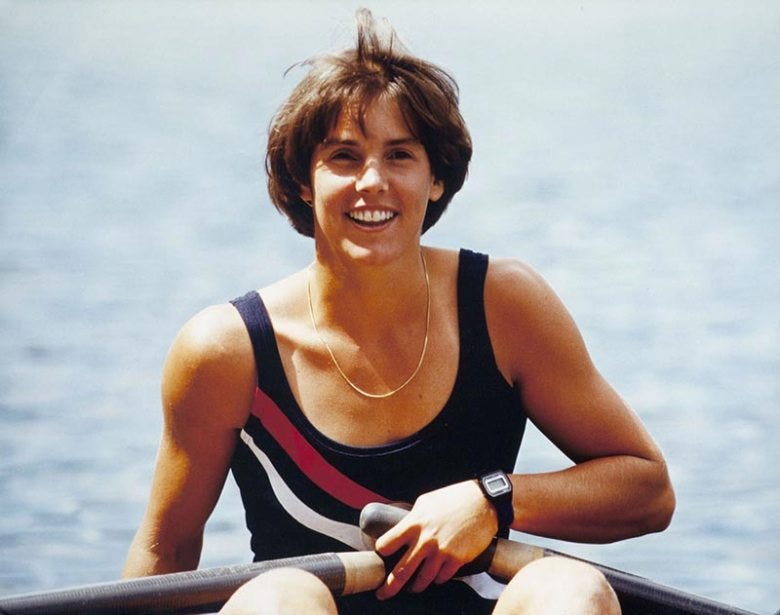
One of my favorite examples is Ginny Gilder, an early member of the women’s rowing team at Yale University in 1976. She and her teammates “shared” a boathouse with the men’s crew. The men had locker rooms and hot showers. The women’s crew shared one toilet. After practice, the women waited on the bus, wet and cold, for the men to emerge warm and dry. Both teams would ride the same bus back to campus, where the women often didn’t have time to shower and warm up before the dining halls closed.
One cold day in March 1976, women’s crew captain Chris Ernst led Ginny and 17 other teammates into the office of Joni Barnett, the director of women’s intercollegiate sports at Yale. Captain Chris gave a nod. The rowers turned their backs, stripped off their sweats, and stood in silence. Naked. Spelled out on their bare backs and chests in Yale-blue marker was a message: TITLE IX.
The women had invited a Yale Daily News photographer and a New York Times stringer to follow along. The bad publicity was enough to force their school to get them a locker room.
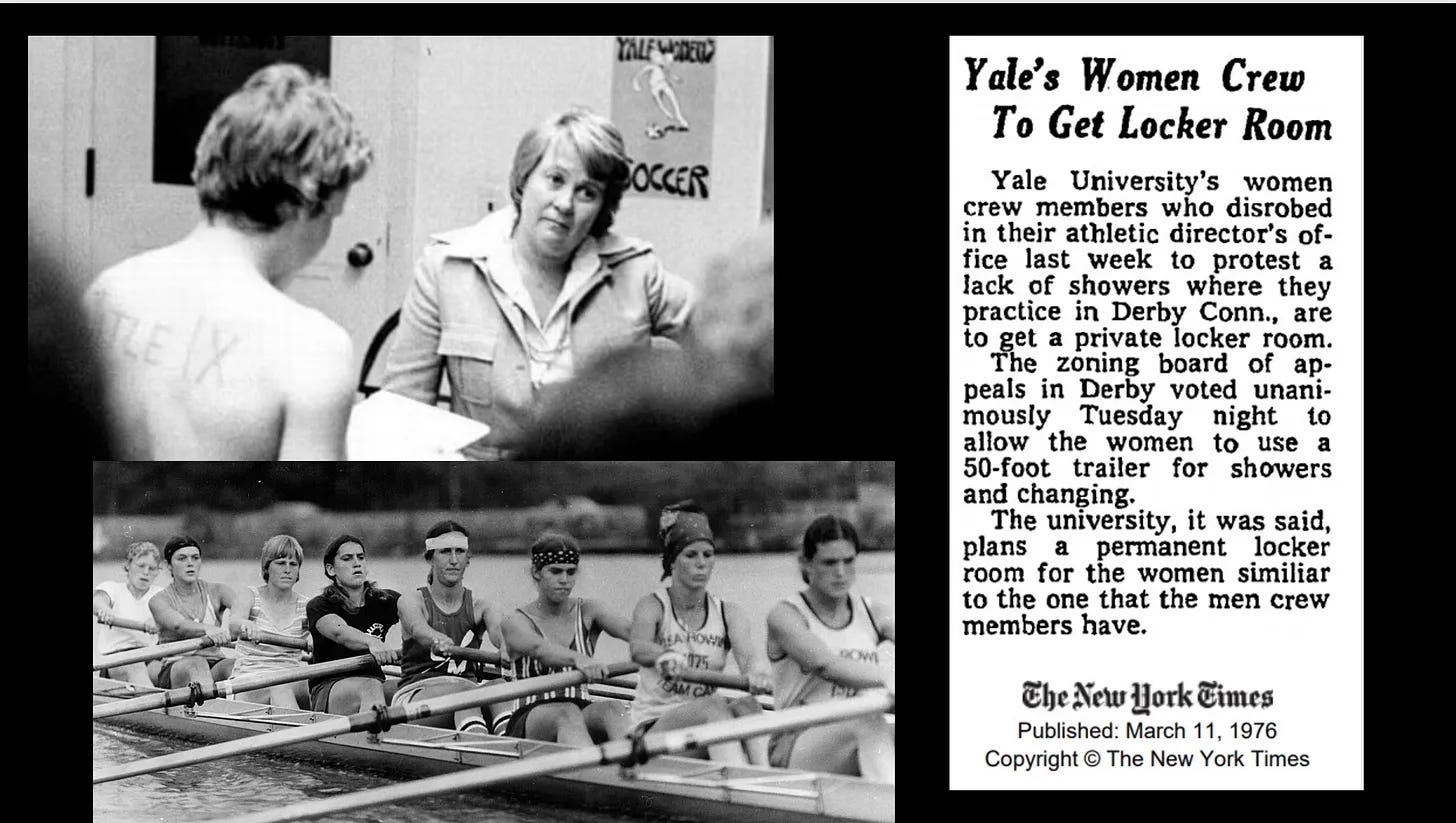
Ginny Gilder went on to become a successful business woman, entrepreneur (latest: Pickle at the Palms), and sports franchise owner. The Yale men’s and women’s crew team now train in the Gilder Boathouse, built with gifts from Gilder’s family and funds she helped raise from many other donors. (ACLU lawyer Wookie Kim, who represented Ashley Badis and her water polo team, trained there as coxswain but didn’t know Ginny’s story until I told him about it while reporting.)
Ginny Gilder is now majority owner of the Seattle Storm, the only WNBA team owned predominantly by women and the first to design and build a dedicated practice facility. Co-owner Lisa Brummel was a four-sport varsity athlete at Yale a couple years after Ginny. Lisa was captain of the women’s basketball and softball teams, played volleyball and competed in shot put, javelin, and discus. Lisa went on to become Executive Vice President of HR at Microsoft.
Another first-generation Title IX athlete, Carol Roberts, was recruited by Yale in 1977 to play field hockey and softball. She survived the “culture wars” and went on to become CFO of International Paper. She became successful enough to donate $4 million of the $6 million needed to build the field house she didn’t have in college. (Her two teams shared one portable toilet.)
In 2018 — more than 46 years after Title IX became law — Yale unveiled the Carol McPhillips Roberts Field House, which supplies both teams with lockers, a training room, coaches’ offices, and an observation deck. At first, she didn’t feel the need to put her name on the building. Then she realized that it was important for female athletes to see a woman’s name on a building.
Jennifer Todd, one of the named plaintiffs in Cohen v Brown University — another landmark Title IX class action lawsuit cited more than any other — faced horrible pushback during the lawsuit. Now a senior VP for the Boston Celtics, she says that several of her co-plaintiffs advocate for women’s rights. They’re part of an underground network of Title IX warriors who help one another.
Patsy Mink was criticized repeatedly throughout her four-decade political career.
“When all of my contemporaries at home say, ‘Oh my goodness, what you’ve done to politics at home” and “I wish we had never heard of Patsy Mink!’ I say, ‘Well, it’s because of all your attitudes that drove me into politics. If you’d given me a job when I came home from law school, I would have been very happy.”
Before she died in 2002, Patsy Mink was campaigning for a thirteenth term. She was 75. Some say she never kept pushing, and maybe this time she should have rested. Her constituents elected her anyway.
She won in a posthumous landslide.
“Discrimination against women is one of the
most insidious forms of prejudice extant in our nation.”
— Patsy Mink, June 24, 1970
Custom Patsy Mink Charm
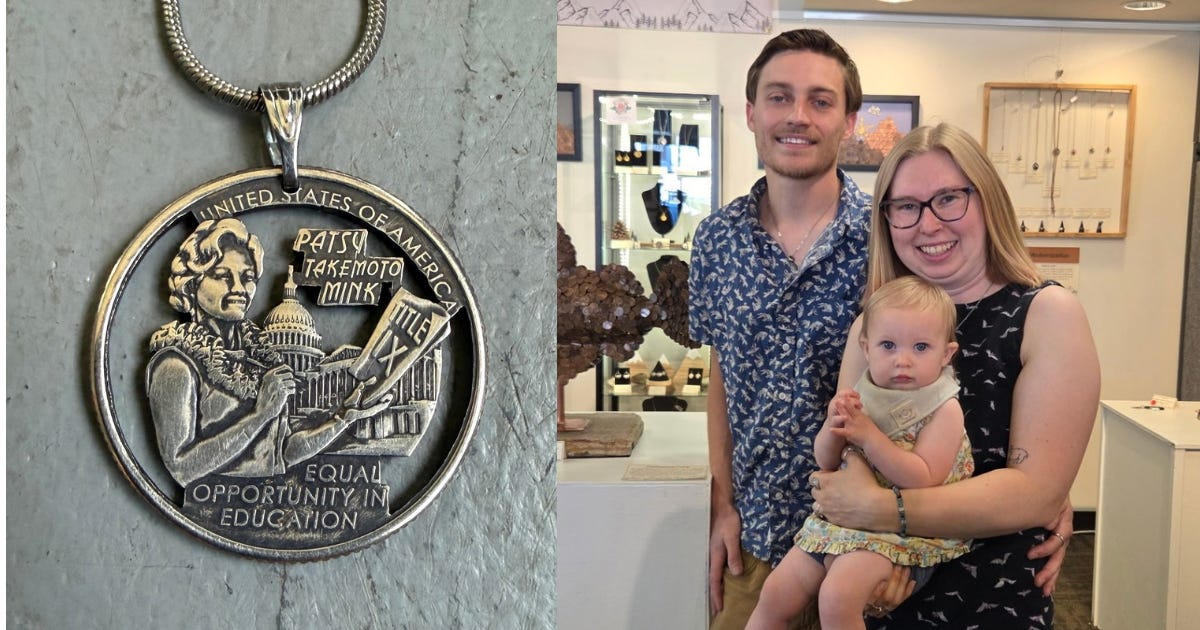
At the Boise Flea Market I met Aidan Poe, a local artisan who makes jewelry out of coins. I asked him to craft two pendants from Patsy Mink quarters, one for me and one for Ashley Badis, who continues to be a Title IX advocate. (Need a guest speaker or keynote or panel member? Consider her! She’s very sell spoken.)
Aidan, a young dad, is delightful, amenable to custom orders, and affordable. If you want to browse his jewelry or inquire about a custom order, find him at Mountainstruck Jewelry or on Instagram at @Mountainstruck.Coin.Jewelry.

Women Helping Girls…And Boys
A couple of years ago, for a Bicycling magazine story, I got to know Shannon Galpin, a pioneering badass woman who supported a generation of teenage girls in Afghanistan change the longstanding cultural prohibition against women riding bicycles. Shannon helped these girls get donated bikes, train for races, and found cycling teams and clubs, including the first co-ed club in the country’s history. (I wrote about it all in The Alchemists, a story anthologized in The Year’s Best Sports Writing.)
When the Taliban returned to power in 2021, Shannon, a single mom working from Scotland, helped more than 100 Afghan women cyclists evacuate to safety. She did it almost entirely through GoFundMe donations and the resourcefulness of a woman who doesn’t wait around for government agencies or institutions to help.
Today, Shannon needs funding to help two young men threatened by the Taliban. Both of these guys were allies and friends of Reihana, Zakia, and Zahra, the young women I wrote about in the Alchemists. Please consider helping if you can.