

Note: To those of you just joining The Waterproof Notebook: Welcome to this little stream of stories about outdoor reporting and narrative craft. To those of you who’ve been with me for a while: Thank you for your patience during my summer-long sabbatical. I want to share the story behind my hiatus… and some insights that might encourage you to prioritize rest and unconventional self-care (whatever that may look like for you). Here’s a 7-minute video update that will answer some key questions. (It also shows off the Tenkara fly-fishing rod and kit I’ll be giving away in a drawing for readers of The Waterproof Notebook!)
This summer, I did something I’ve never done before: I dedicated three months to not-writing.
As I noted in a previous issue, I flew to Alaska in June with one primary objective: to spend the summer doing something other than staring at a screen. I needed to process my mother’s traumatic death and let my nervous system calm down.
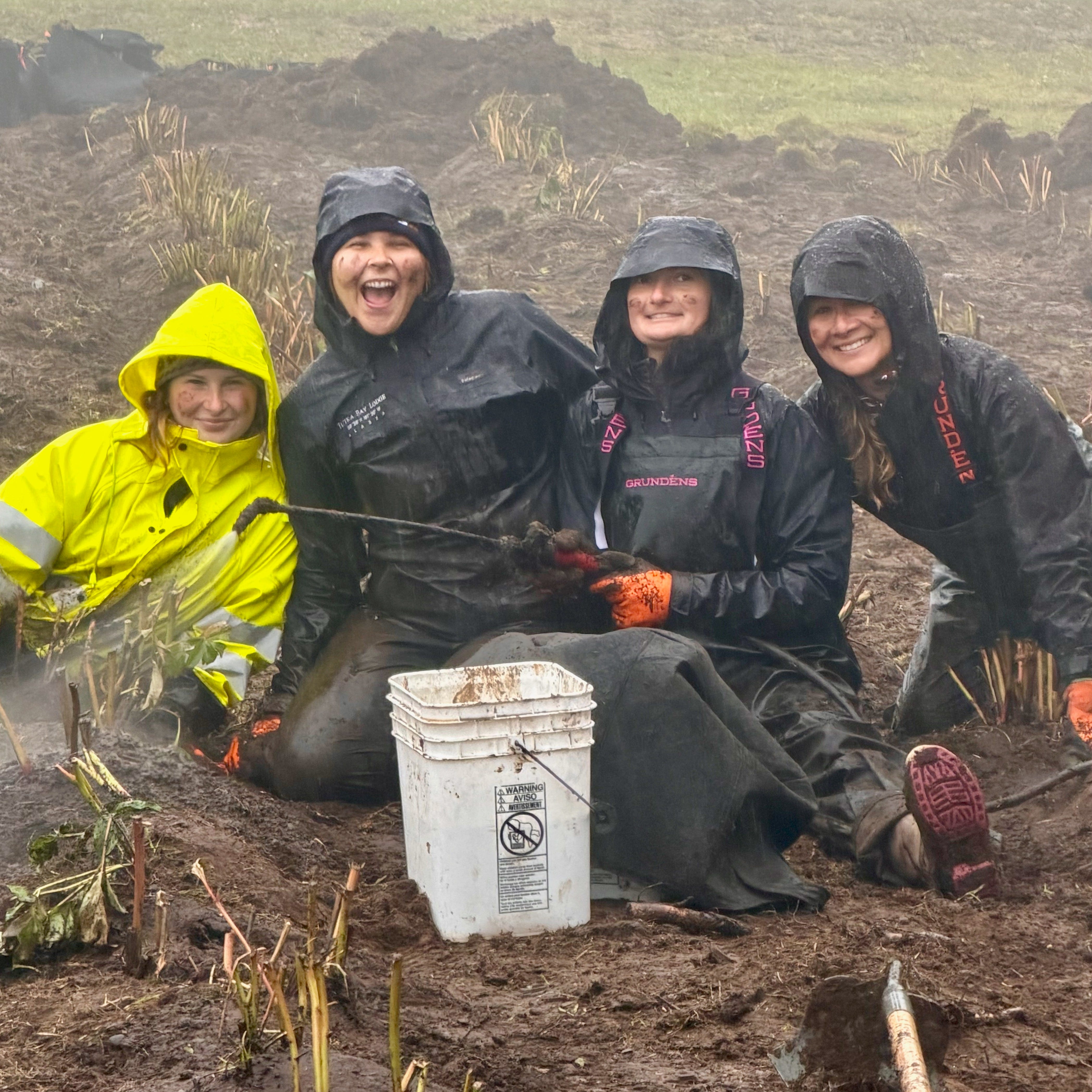
I got a job on a peony farm, joining three other women much younger than me. Marie (24, from Ohio by way of Australia), Niki (30, from Tampa), and Kaitlyn (22, from North Carolina) had come to the farm in the spring, when the ground was still frozen. I was an unexpected addition in June, as the peonies were starting to bud.
We spent eight hours a day together in the fields and shared a Victorian house with views of Kachemak Bay. One of the most delightful surprises of my summer was that three generations of women from different backgrounds could live, work, and play together all summer with so little drama.
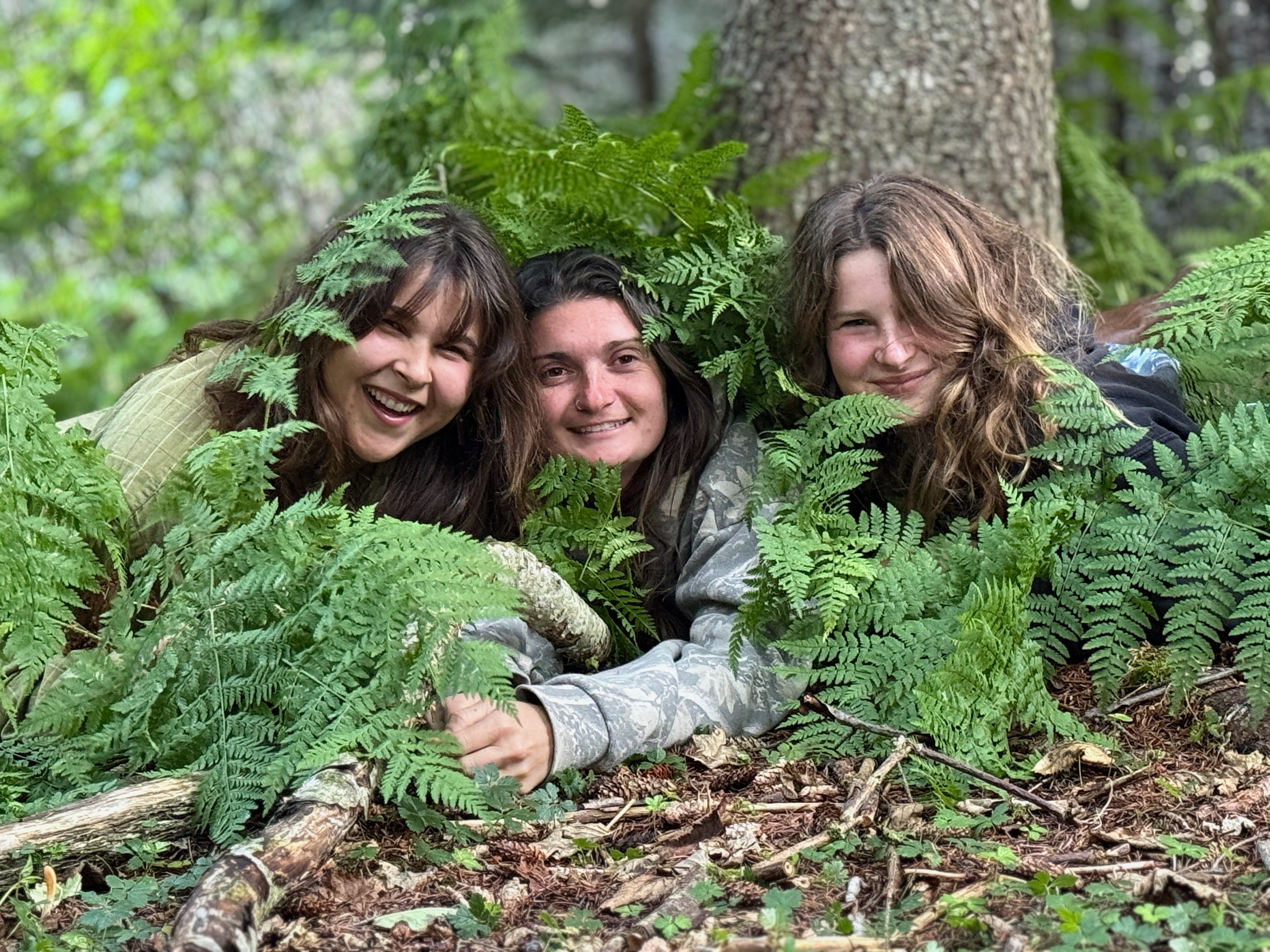
The summer’s drama came (mostly) from the peonies. The season unfolded in three distinct acts, each with its own pace, vibe, and insights.
Act I: Waiting
June and July involved weeding eight hours a day, pulling horsehair, fireweed, hawkweed, wild geraniums, and dandelions the size of small trees. Once the peonies began to bud, we pinched off secondary buds so the plants could pour their energy into fewer, bigger blooms.
This part of the season felt more like garden piddling than farm labor. I listened to audiobooks, enjoyed the scent of dirt and the warmth of sun on skin. I also directed my mental energy toward processing my mother’s death, which I’d been forced to compartmentalize in order to meet several hard deadlines. (Including this longform Title IX story, which I dedicated to her.) Sometimes I’d sob in the peonies. The peonies absorbed it. Then I’d look up and see a pair of resident sand hill cranes or a moose and feel a little bit lighter.
Our boss, Kirsten Dixon, is a James Beard-nominated chef and adventure lodge owner. She put us to work on all sorts of fun tasks, from picking wildflowers for table arrangements to cleaning guest houses and serving at catered events on the farm. It was fun wearing different hats and not being the one in charge! Here’s what this looked like:
What it taught me: It’s okay to get off the productivity train. There’s much to be gained by slowing down, or even pausing. I found gratification in small, repetitive, cumulative efforts. Mom’s Alzheimer’s had sent my nervous system into fight-or-flight mode. Could weeding really help reset it? Apparently so! Science has found that “people experience an unconscious calming reaction to touching a plant.” Weeds for the win!
Act II: Harvest
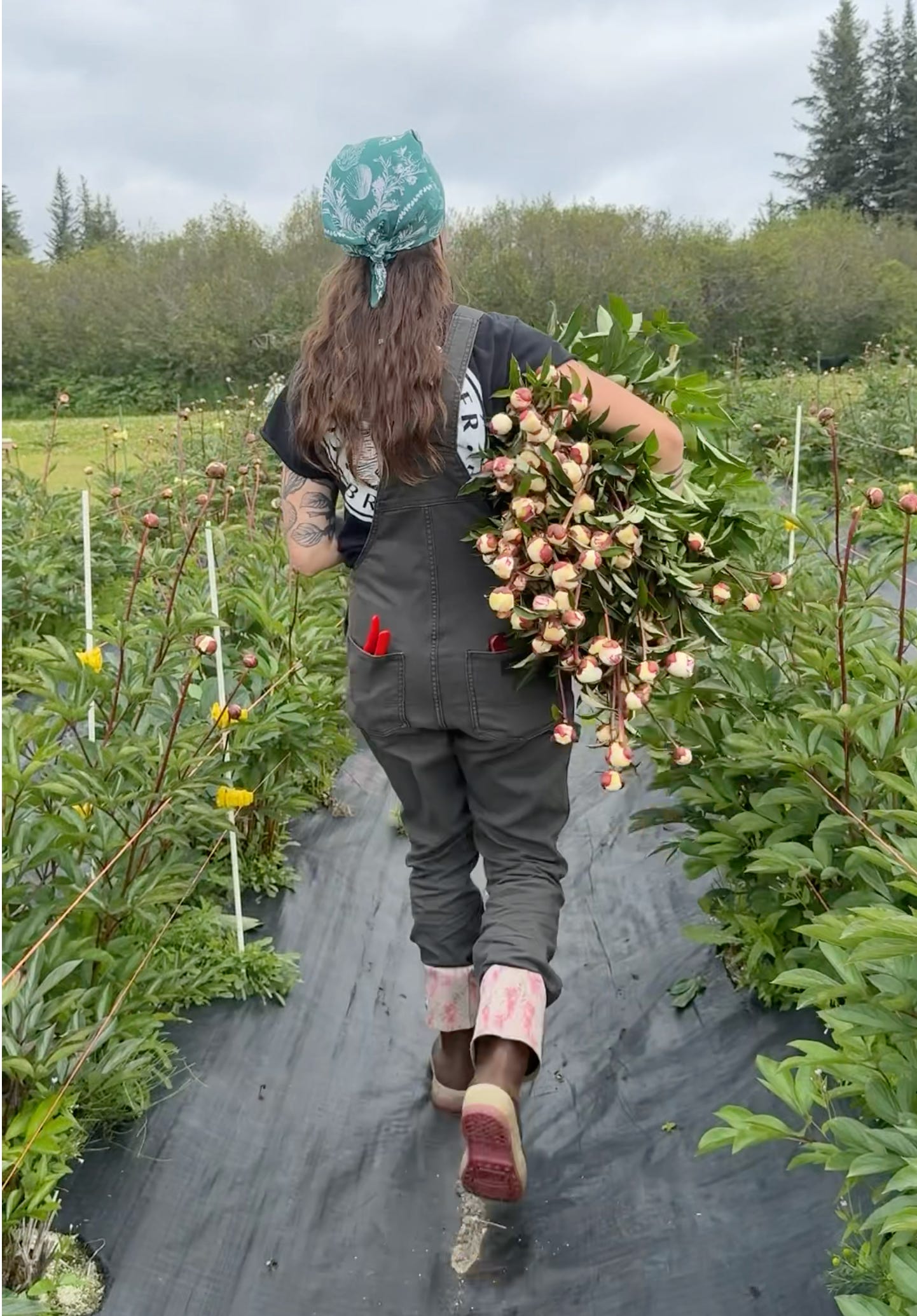
At II began when the first peony bloomed in late July. It began as a trickle — a few pops of color here and there. We had to pinch every bud to determine whether it was ready to be picked. The “just right” window can be as small as four hours: too soon and they won’t open; too late and they’ll bloom before reaching the buyer.
At first I hovered over each bud, clippers poised, in analysis paralysis. And then the fields exploded. No time to think! We hurried through the fields of ticking flower bombs, cutting each stem long and tucking them under one arm.
We had to harvest twice a day to keep up. We rushed them into the walk-in cooler, where the 34-degree temperature paused the blooming. Each stem had to be stripped of foliage, cut to length, graded by bud size, bundled, and counted. All by hand.
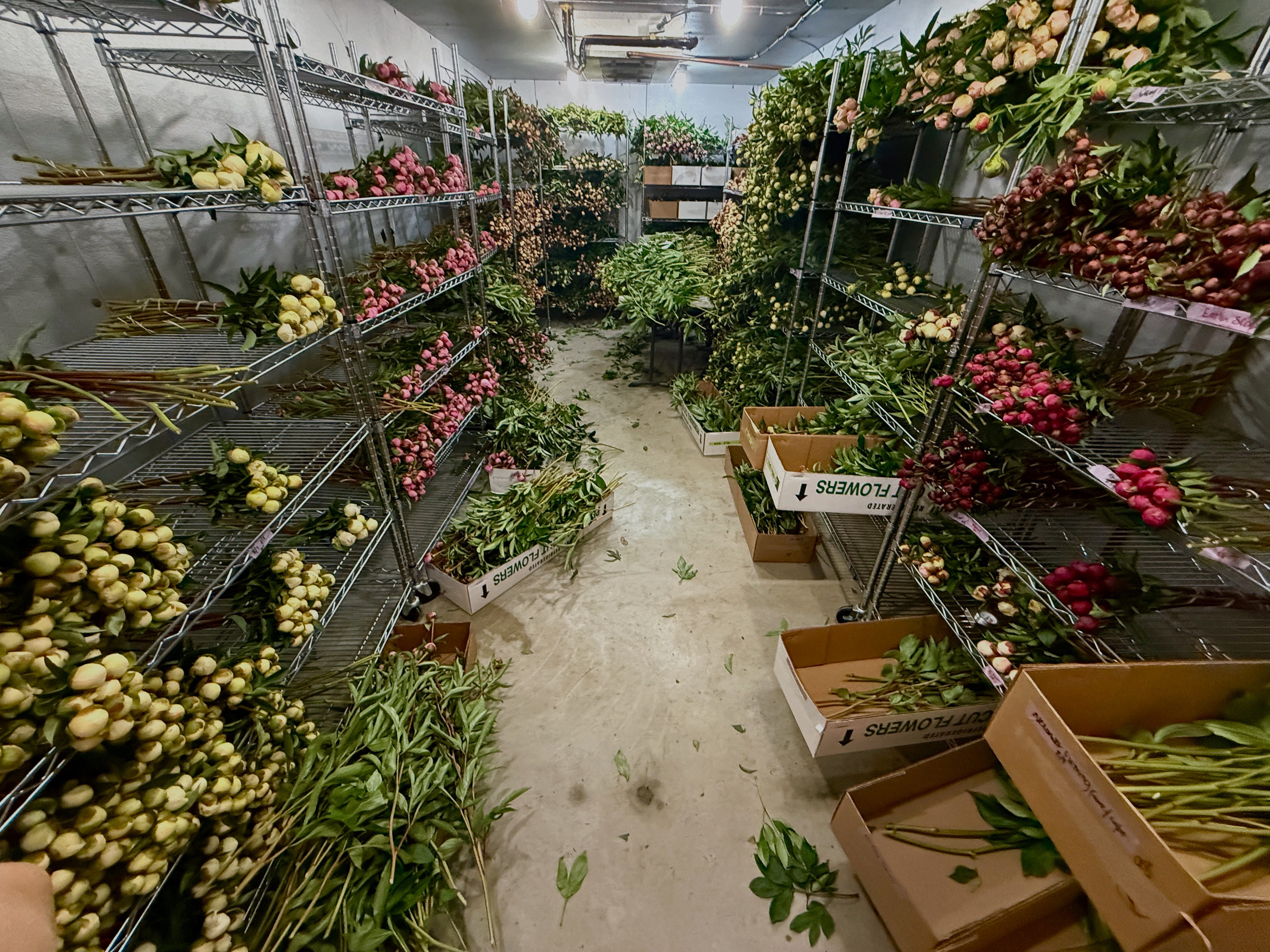
With thousands piling up each day, we were drowning in beauty, overwhelmed by abundance. None of us had ever done this before, so we struggled to prioritize. What task needed to be done most urgently? Everything. Everywhere. All at once. It felt like that chocolate factory scene from I Love Lucy.

In the span of about four weeks, we picked and processed 16,000 peonies. And then, just as suddenly as it started, it was over. We walked each row again and again, dead-heading the dying flowers.
What it taught me: The impermanence of beauty and the beauty of impermanence. Mono no aware is a Japanese concept that describes a bittersweet awareness of the fleeting, ephemeral nature of existence. I felt that deeply as I noticed how much the peonies could change in one day. I found I had “favorites.” The Sarah Bernhardts in Field B. The Monsieur Jules Elie blooms in Field C. I fell in love with a particular coral, my single favorite flower of the season. I photographed it in its prime, and as it aged and died.
Act III: Planting
Then began Act III: Planting. Our boss purchased 600 peony plants from a woman-run farm in Ninilchik. The roots came in 50-pound bags of dirt that had to be loaded, unloaded, and planted by our 4-woman team.
This was heavy lifting. We dug up dead peony roots and enlarged the holes to make room for the transplants. Someone with an excavator dug a whole new field of rows, and we learned to prepare the soil with a mixture of bone meal, dolomitic lime, and borax. It was a dirty job.
Lifting those 50-pound bags was perhaps the only task I did not enjoy. They were awkward and unwieldy, and I felt constantly on the verge of throwing out my back. The days were growing shorter, the air was cooler, and it was raining, which made the dirt heavier and the work even harder. Morale took a bit of a dive.
What it taught me: Teamwork matters, and small acts of kindness and grace build trust and friendship. If one person wasn’t fully functioning on a particular day—and each of us had those days—the others stepped up. Some days our boss would surprise us with cookies or a round of lattes or some other small treat, and those little morale-boosting moments made a difference. The hard, rainy, muddy days gave me a new level of appreciation for well-designed waterproof gear. My Grunden’s Pisces bibs were designed with a drop-seat panel that made bathroom breaks easier, and these $10 Vallation felt insoles made my Xtratuf boots feel twice as cushy and warm.
How did not-writing help my writing?
My father, a technical writer and a scientist, used to tell me, “Even when you’re not writing, you’re writing.” His favorite way of “not-writing” was fishing. When you put your hands and your body in motion, it occupies your conscious mind and frees your subconscious to solve the riddles of your writing. It’s sort of like distracting a toddler by giving him a toy.
I was, honestly, scared about writing after three full months off. When I got home and sat down to write my first big longform piece after the break — a 6,500 braided narrative — I felt a notch or two more than the normal anxiety I feel when starting any new piece.
At first, I felt pretty rusty. The first few paragraphs were a mess. But as I got going, the rust flaked off and the words began to flow again. It was like that first day back in the gym. The mental muscles were sore, but they also felt good to be back in use.
I think more than anything, the break reinforced what I’ve always known: I need to write. It’s what I’m meant to do. But it’s also okay to have a Writing Season and a Not-Writing Season. More on that in a future issue.
The Art of Not-Writing
If I don’t write every day — whether it’s scribbling a quote in my notebook or revising a story on deadline — I feel a bit constipated. Over the summer, my creative energy began to accumulate like water behind a dam. It needed an outlet.
Before the peonies began to bloom, I spent my evenings piddling around with sashiko, the Japanese art of visible mending. Based on the creative use of a simple running stitch to create elaborate patterns, sashiko (which translates to “little stabs”) originated in Japan during the Edo period (1603 - 1868), when fishermen and farmers reinforced worn clothing with patches and thread.
I struggle to sit still and rest. Sashiko gave me something to do with my hands while listening to audio books and recovering from a long day of physical labor. It was both mindless and mindful, and I really enjoyed the visible progress and sense of completion when I finished patching a pair of Carhartts or upcycling this $5 thrifted denim shirt:
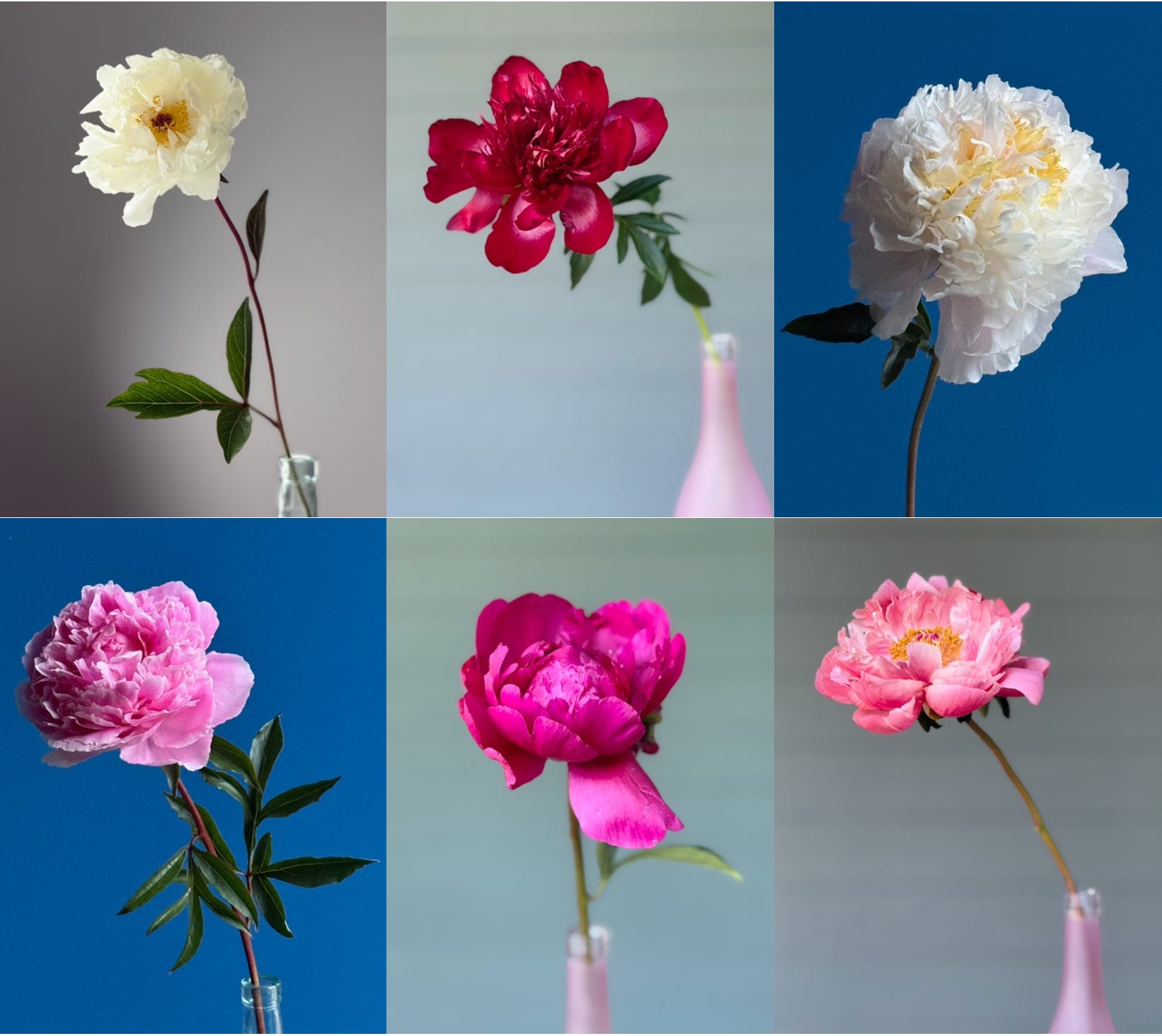
When the peonies began to bloom, our boss instructed us to let a percentage of the peonies bloom in the fields. I scoured the rows — all 7,000 plants — for the most interesting specimen of each variety. I cut these singular flowers, brought them home, and conducted a portrait session in a makeshift studio in my bathroom, which had exquisite natural light. I played with light and attempted to capture the distinct personality of a particular flower at its peak.
Here are a few of my favorites. I plan to print them as postcards for a future giveaway on The Waterproof Notebook. (I used no filters, no fancy lighting, no AI. Just window light and my iPhone in Portrait Mode for a shallow depth of field.)
Kim’s Whims
This is where I share a few things that bring me joy.
Elegantly Wasted - This song by Leon Bridges and Hermanos Gutierrez is intoxicatingly mesmerizing. How would you describe this genre of music?
Words of Taoism: “We often think strength means resistance—pushing, grinding, overcoming. But water teaches something different: yielding without giving up. It doesn’t resist the rock. It flows around it. And slowly, quietly, it reshapes the landscape.”
This sashiko kit ($36) got me started on the basics with three classic Japanese patterns. If you want to give it a try, this has everything you need.
A Gift From the Sea, by Anne Morrow Lindbergh, was given to me by my dear writer friend Elizabeth Sharp McKetta. I re-read it when I want to feel the calming presence of the sea.
Dog-jouring on a surf skate. I have a dogshare pup named Hopper who lives with us part time, and I’m training him to pull me on a longboard with dog-mushing commands. Hopper (an Australian shepherd) needs exercise and a job, and he makes everyone we pass on the Greenbelt light up with a smile.
What’s Next: Giveaways!
I’m going to be doing a few fun giveaways over the next few months! I’ve got a waxed-canvas pocket notebook cover from one of my favorite brands, a packet of peony postcards made by yours truly, a bit of decorative sashiko I made, and a beginner-friendly fly fishing rod that is currently bringing me a ton of joy.
Every subscriber (free or paid) will be entered in the giveaway, which will basically be a drawing (for legal reasons, I think I need to call it a “sweepstakes.”) Free subscribers will receive one entry, and paid subscribers will get five entries. Folks who refer a ton of new subscribers to The Waterproof Notebook (looking at you Tommy T, Erika H, Brendan O, and Mallary T!) will get 10 entries.
If you want an extra 5 entries, let me know which item you’d be most stoked to receive. (You can simply reply to this email.)
Parting Shot
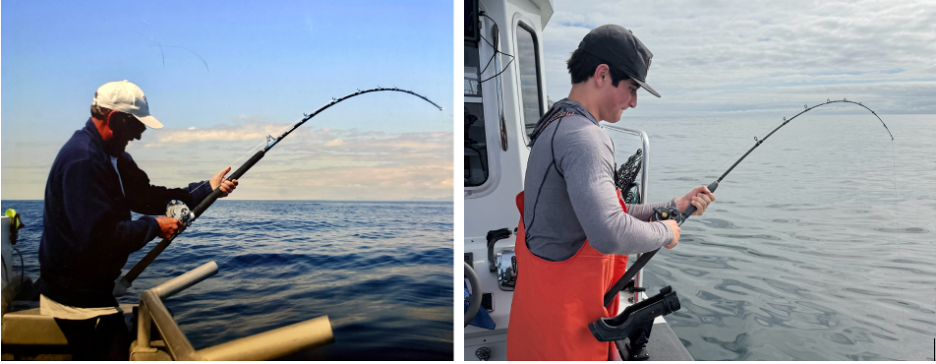
My 18-year-old son spent the summer working on a commercial salmon boat in Alaska. After the season, some friends took us fishing for halibut and rockfish on a deep-sea boat out of Seward. This was the first time he’s ever experienced my dad’s favorite kind of fishing. At one point we both had a fish on and were reeling side by side. I looked over at him and saw my father’s body language.
Ok I love this. Filing it away so someday when I need a break for my body and my brain, I remember your inspiring adventure. ❤️
This is the BEST! It has given me hours of mind expansion, learning, good feelings and nervous system healing. Wow, thank you for this Kim!